Accessible to Whom?: When Personal Software Becomes a Product
There has probably never been a better time to build bad software.
Not bad in the sense that it does not work. Quite the opposite.
You can describe an idea to an AI coding tool and, within hours, have something surprisingly functional: a utility for organising photographs, a dashboard for tracking expenses, or a tool that generates presentation mock-ups exactly the way you like them.
If you built it for yourself, accessibility might barely enter the conversation.
You know where everything is. You understand the strange icon you used. You know the unlabeled button in the corner exports the file. The colour combination works for you. The keyboard behaviour does not matter to your own workflow because you use a mouse.
And, within reason, that can be fine. Personal software has an audience of one.
“The accessibility assumptions that barely matter when the audience is one become pivotal when the audience becomes everyone else.”
Something changes when you put the tool on the internet. Someone else finds it useful. Then ten people do. You add accounts, authentication, payments, perhaps a subscription.
What began as software for you has become software for people you do not know.
You do not know how they see. You do not know how they move. You do not know whether they navigate with a keyboard, enlarge text, use voice control, rely on a screen reader, or experience the interface differently from you.
AI is dramatically shortening the distance between those two states.
From personal software to public responsibility
The current conversation around AI-assisted development is understandably optimistic. More people can build. Teams can move faster. Designers can create working interfaces. Developers can generate large amounts of implementation from descriptions. Small, specialised pieces of software can exist without needing the economics of a traditional software company.
Those possibilities are real. But democratising software creation has a second consequence: we are not only creating more software. We are creating more software that can become somebody else’s software.
The prototype can become the product remarkably quickly. The internal tool can acquire external users. The weekend experiment can gain a payment screen. Somewhere during that transition, the standard changes.
Accessibility does not suddenly become morally relevant only when money changes hands. Personal tools can be accessible, and their creators may themselves depend on accessible interaction. The point is narrower: once a product is intended for a broader public, the consequences of inaccessible decisions expand, and commercial services may acquire explicit legal obligations.
The threshold changed in Europe
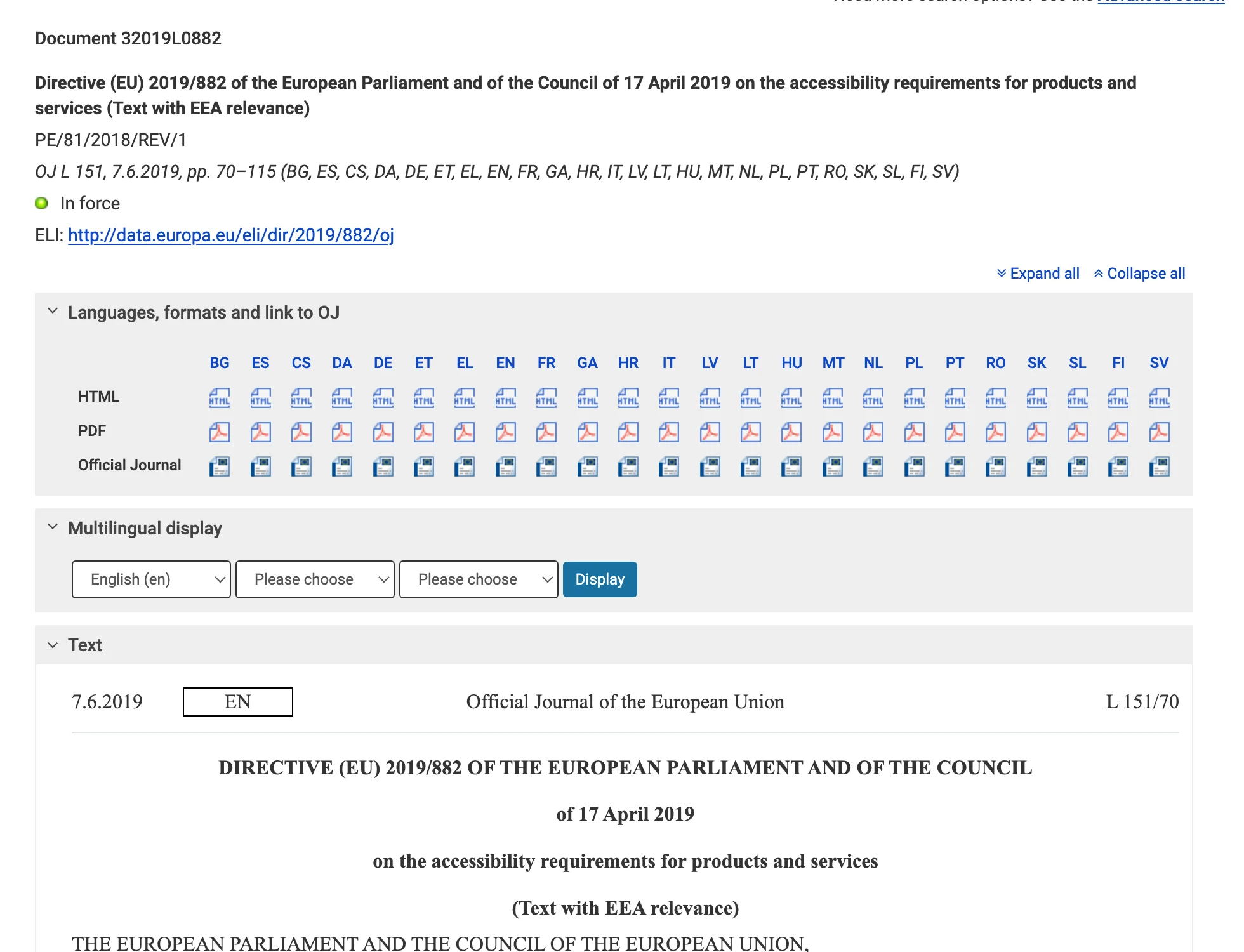
On 28 June 2025, the accessibility requirements of the European Accessibility Act began applying across the European Union. The Directive covers specified products and services including e-commerce, consumer banking, electronic communications and parts of passenger transport. In transport, its scope reaches websites, mobile applications, electronic ticketing, electronic tickets and certain self-service terminals.¹
The Act contains qualifications. Microenterprises providing services are exempt from its requirements, and the Directive contains provisions for fundamental alteration and disproportionate burden. The precise obligation therefore depends on the product, service and circumstances.¹
But the broader direction is difficult to miss. For commercial digital services within scope, accessibility is not simply a backlog item labelled “nice to have”. It becomes part of the conditions under which the service is offered.
“AI lowers the barrier to creating a product. Accessibility reminds us that the barrier to creating a responsible product is higher than getting it to work.”
The timing matters. One development makes interfaces dramatically easier to produce. The other makes it harder to defend excluding people from those interfaces.
The European Commission describes the EAA as establishing common accessibility requirements for key products and services and notes that around 100 million people in the EU live with a disability.² The impact is therefore not an abstract compliance exercise. It concerns whether people can independently buy, bank, communicate, travel and participate in ordinary digital life.
Faster does not mean more accessible
Generative development introduces a tempting assumption: if a model has seen accessibility guidance, perhaps accessibility arrives automatically with the generated code.
The evidence is more complicated. A 2025 empirical study comparing web code generated by GPT-4o and Qwen2.5-Coder with human-written code found that the models often performed well on basic accessibility features such as colour contrast and alternative text, but continued to struggle with more complex issues including ARIA. Feedback-driven techniques improved the results.³
That finding prevents two easy conclusions. AI-generated code is not inherently inaccessible. But AI knowledge of accessibility does not make an interface accessible by guarantee.
Accessibility depends on context. A model can know that an image may need alternative text without knowing whether this particular image is decorative, informative, functional or redundant. It can know ARIA without correctly modelling a novel interaction. It can produce technically valid controls inside a journey that remains confusing or impossible to complete.
“When the cost of producing an interface falls, the cost of a bad default rises.”
A weak component used once is a defect. A weak component embedded in a design system, copied by an agent and instantiated across hundreds of generated screens becomes infrastructure.
Accessibility is architecture
This is why accessibility cannot be reduced to contrast checks and alternative text at the end of delivery.
Consider booking a flight. A traveller has to search, filter, compare, understand baggage, select an itinerary, enter passenger information, authenticate, pay, retrieve a ticket and potentially respond to disruption. Individual screens can pass automated checks while the journey as a whole remains difficult or impossible to complete.
The EAA is relevant here precisely because it reaches functional parts of commercial services, including e-commerce and passenger-transport interactions.¹ Accessibility has to survive the journey, not merely the component audit.
WCAG makes the architectural point explicit. Its “Robust” principle requires content to be interpretable by a wide variety of user agents, including assistive technologies. Success Criterion 4.1.2 requires interface components to expose programmatically determinable names and roles, as well as states and values where relevant.⁴
That means a visual interface has always had another representation underneath it. A heading is not merely large text. A button is not merely a rectangle. A checkbox has a state. A form control has a name. The semantics are part of the interface.
Then something unexpected happens
Those semantics now have another audience.
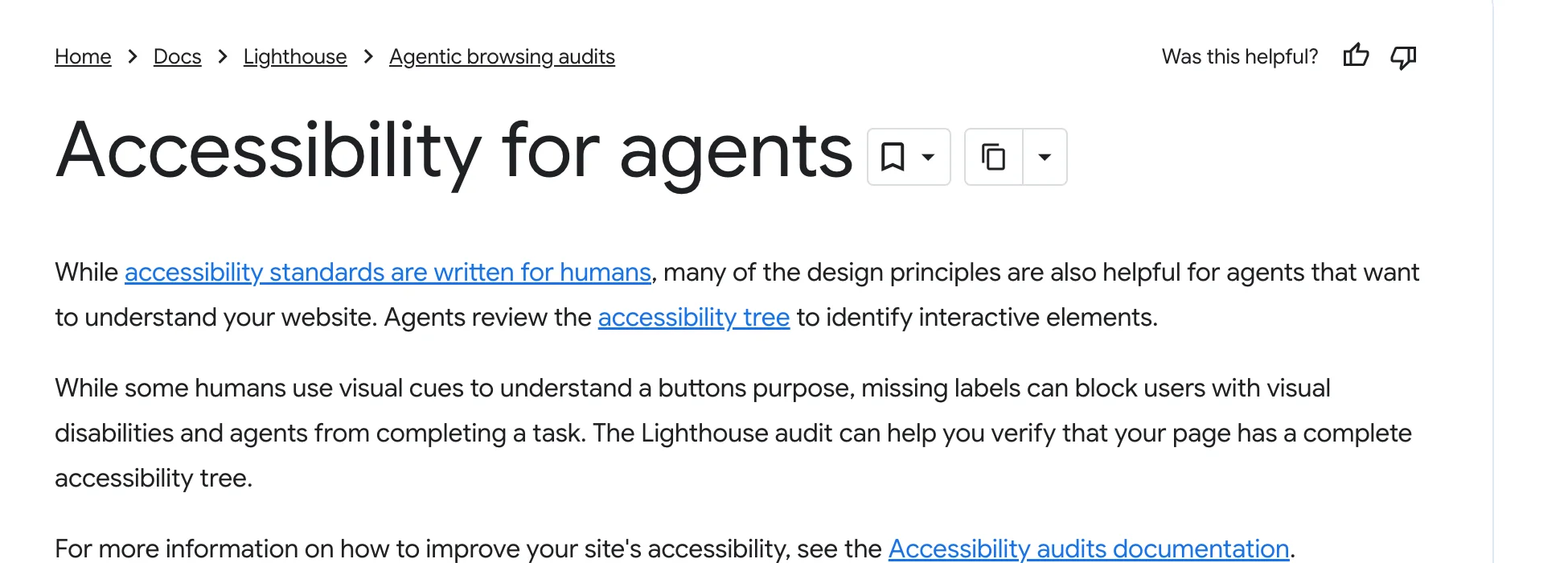
Chrome’s documentation for agentic browsing explicitly describes “accessibility for agents”. It explains that agents can use the accessibility tree to identify and understand interactive elements, and that missing accessible information can create problems for both assistive-technology users and agents.⁵
This is not because accessibility standards were secretly designed for AI. They were not. It is because both assistive technology and some agents benefit from meaning that survives beyond visual appearance.
A custom clickable with an icon may be obvious to a sighted mouse user while exposing little useful information programmatically. A native button with an accurate accessible name carries its purpose into another layer of the system.
“The web spent decades learning how to make interfaces understandable beyond pixels. Agents have unexpectedly become another consumer of that work.”
This creates an additional incentive for semantic quality, but it should not replace the original reason for doing the work. Accessibility is for people. The fact that machines also benefit is a consequence, not the justification.
Do not confuse the beneficiaries
“Agent accessible” and “human accessible” are not synonyms.
A visual computer-use agent may successfully click an unlabeled icon that remains inaccessible to a screen-reader user. A perfectly labelled form may be easy for software to parse while still being exhausting for someone with a cognitive disability. A machine-readable action can still have terrible contrast. A structured API can be flawless while the human product built on top of it remains impossible to navigate with a keyboard.
The overlap is useful, but the experiences are different.
It is therefore helpful to distinguish three layers: human perceptual and interaction accessibility; semantic accessibility that exposes meaning programmatically; and explicit agent interoperability, where systems expose actions or tools directly rather than forcing software to reconstruct every task through the human interface.
These layers can reinforce one another, but none proves the others.
Design for the system, not the demo
The practical response is not to append “make it accessible” to the end of an AI prompt.
Accessibility needs to be encoded into the environment from which software is generated: components with correct semantics and keyboard behaviour, tokens that preserve contrast, content patterns, linting, automated tests, agent instructions, acceptance criteria, code review and testing with people who actually use assistive technologies.
If an accessible component library is the easiest thing for an agent to use, generation begins from a stronger default. If the design system contains inaccessible custom controls, the agent can reproduce those just as efficiently.
“AI can accelerate implementation. It does not outsource responsibility.”
This is one of the more important consequences of the EAA for teams adopting AI development tools. The organisation deploying the service still owns the outcome. The origin of the code does not change the experience of the person who cannot use it.
Accessible by default is not accessible by guarantee
Even strong foundations are not enough on their own.
Components can be accessible individually and inaccessible in combination. A dialog can manage focus correctly while appearing at the wrong moment. Every image can have alternative text while the descriptions are useless. Every heading can use valid markup while the information architecture remains incoherent.
Accessibility is partly a property of components. It is also a property of relationships, tasks and lived experience.
That is why an agent can help test accessibility without becoming the final authority on it. Automated evaluation is valuable. Human experience remains the system we are trying to support.
The new meaning of robust
There is an optimistic interpretation of this convergence.
For years, accessibility advocates have argued for semantic HTML, meaningful labels, predictable interaction, structured content and standards-based controls. These practices were sometimes treated as specialist requirements.
Now some of the same qualities also make products easier for machines to understand. That creates an additional economic incentive for work that should already have been happening.
The cynical version is uncomfortable: organisations may become interested in semantics because agents affect automation, discoverability or revenue. But the direction of the argument matters. Accessibility should not become valuable because machines need it.
“An interface that only communicates through appearance is an incomplete interface.”
WCAG’s word “robust” is becoming unexpectedly useful. The digital environment now contains browsers, assistive technologies, humans, visual agents, semantic agents and increasingly explicit machine-facing capabilities. Products have more than one surface.
The screen is one. The accessibility tree is another. The underlying capabilities may become another still.
The challenge of the AI era is not simply teaching machines how to use the web. It is making sure that, while we teach machines to use it and make software easier to create, we do not build a web that leaves people behind.
References
- Directive (EU) 2019/882 of the European Parliament and of the Council, 17 April 2019, European Accessibility Act. Source
- European Commission, “The EU becomes more accessible for all”, 31 July 2025. Source
- Hyunjae Suh, Mahan Tafreshipour, Sam Malek and Iftekhar Ahmed, “Human or LLM? A Comparative Study on Accessible Code Generation Capability”, 2025. Source
- W3C, Web Content Accessibility Guidelines (WCAG) 2.2, Principle 4: Robust and Success Criterion 4.1.2 Name, Role, Value. Source
- Chrome for Developers, “Accessibility for agents”, 2026. Source