The Design System Is Actually a Negotiation System
Components are the visible output. The harder work is deciding who gets to make which decisions.
A product team needs a new component. The design-system team says an existing component almost solves the problem. The product designer says “almost” is precisely the issue. Engineering does not want another implementation. Accessibility identifies behaviour that neither proposal handles properly. Another team appears with a similar requirement, but not quite the same one.
Eventually someone asks:
Should this go into the design system?
It sounds like a component question. Often, it is actually a question about authority.
- Who is allowed to make this decision locally?
- When does that decision become shared?
- What evidence is required before everyone else inherits it?
Components are evidence of decisions already made
A button in a mature design system represents far more than a rectangle with a label. Somebody has already made decisions about interaction states.
Spacing. Typography. Focus behaviour. Keyboard interaction. Contrast. Disabled states. Touch targets. Implementation. Usage. Possibly analytics and localisation.
When a product team consumes that button, it receives all of those decisions together. This is where much of the leverage comes from. The organisation stops repeatedly solving problems it has already solved.
But there is another side to that efficiency. Every shared decision removes some local freedom. That makes a design system an organisational mechanism for allocating decision rights.
Standardisation always draws a boundary
Imagine two extremes.
In the first organisation, every team can invent whatever it needs. Local speed is high. The cost appears later through duplication, inconsistent behaviour, fragmented implementation and repeated accessibility work.
At the opposite extreme, nothing can change without the central system team. Consistency is high. Now experimentation slows, context gets flattened and the system becomes a bottleneck.
Neither extreme is especially attractive. The real work is deciding where the boundary belongs.
Some decisions should be global. Some should belong to a platform. Some belong to a product family. Some should remain intentionally local.
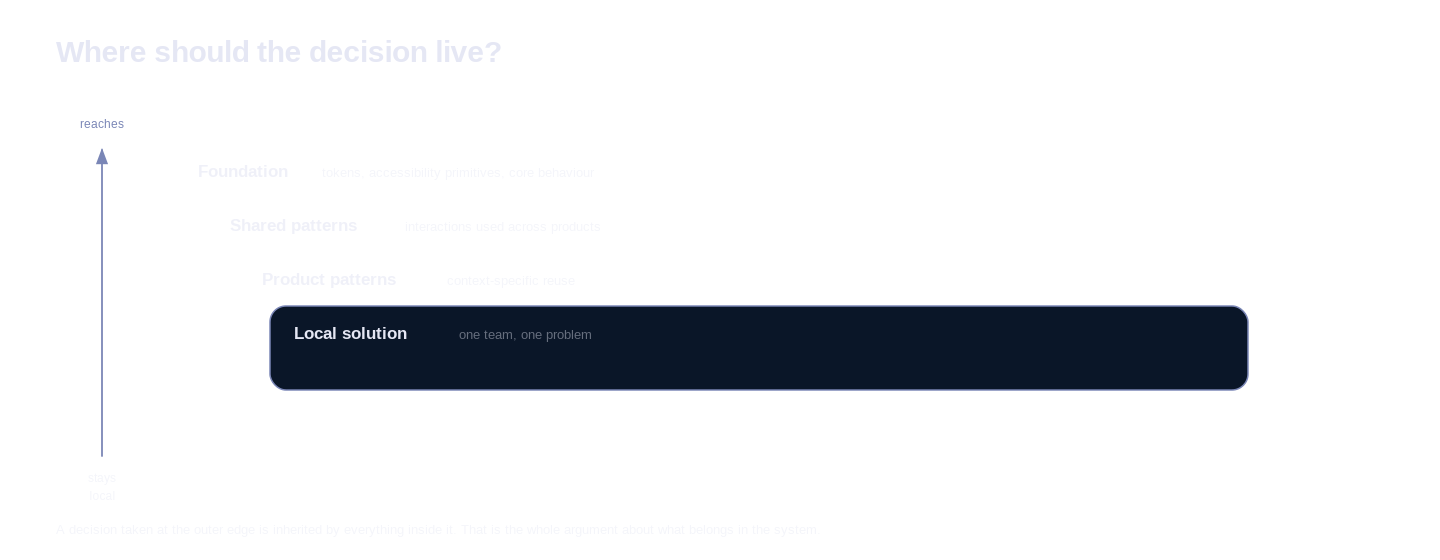
This makes a mature design system less like a catalogue and more like a negotiated boundary between autonomy and coherence.
GOV.UK makes the burden of proof unusually visible
Most organisations do this negotiation internally. GOV.UK exposes a substantial part of it publicly.
A new proposed component or pattern first needs to demonstrate that it is useful to multiple teams or services and unique relative to what already exists.
Before publication, the implementation is reviewed for usability, consistency and versatility, including evidence from user research and testing with disabled users.[1]
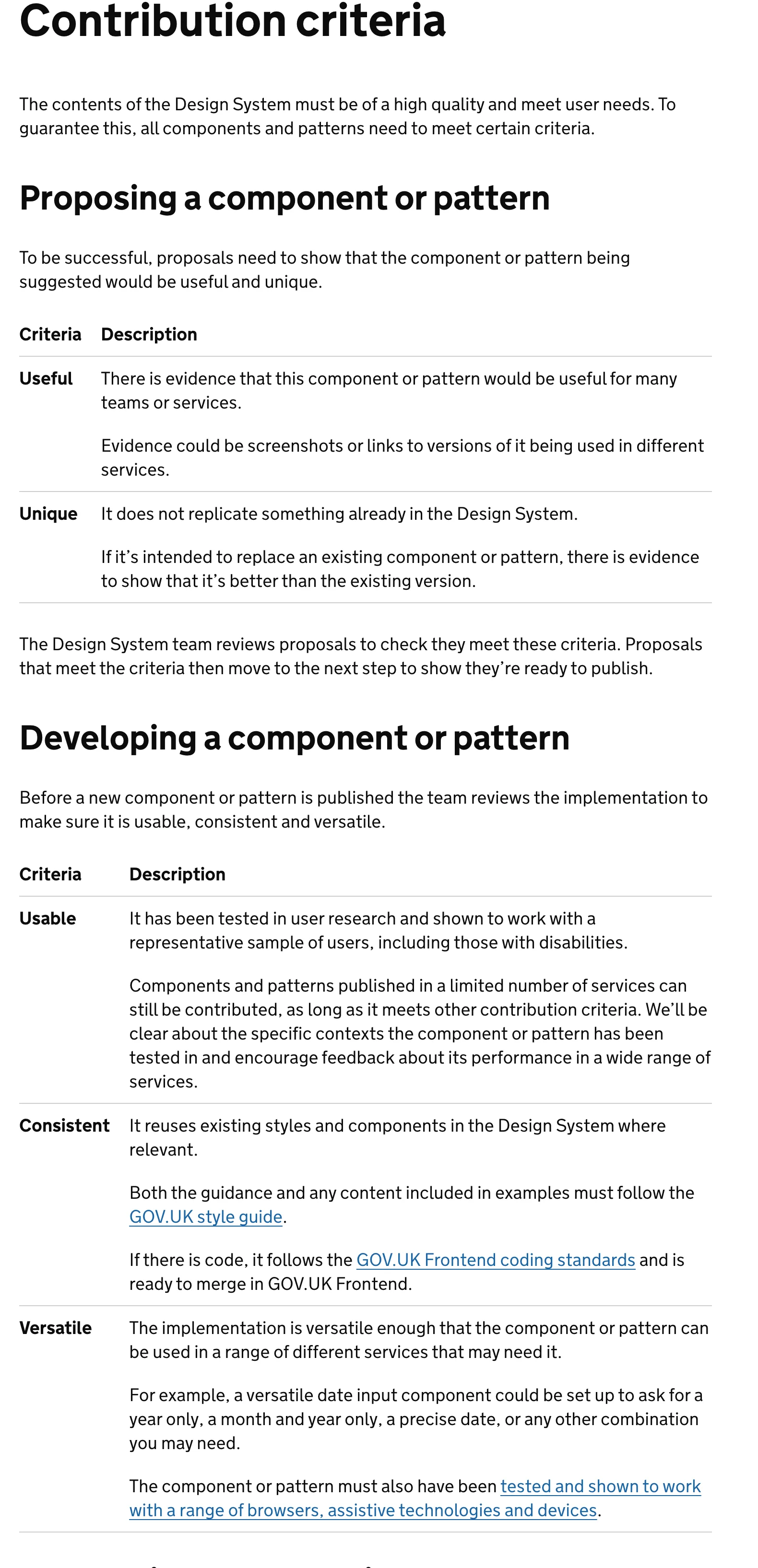
Look at what the process is actually doing. A single team is free to encounter a problem. That does not automatically give the solution authority over every other team.
The burden of proof rises when the scope of the decision rises. That is the negotiation.
This suggests a useful principle:
Governance should increase with blast radius.
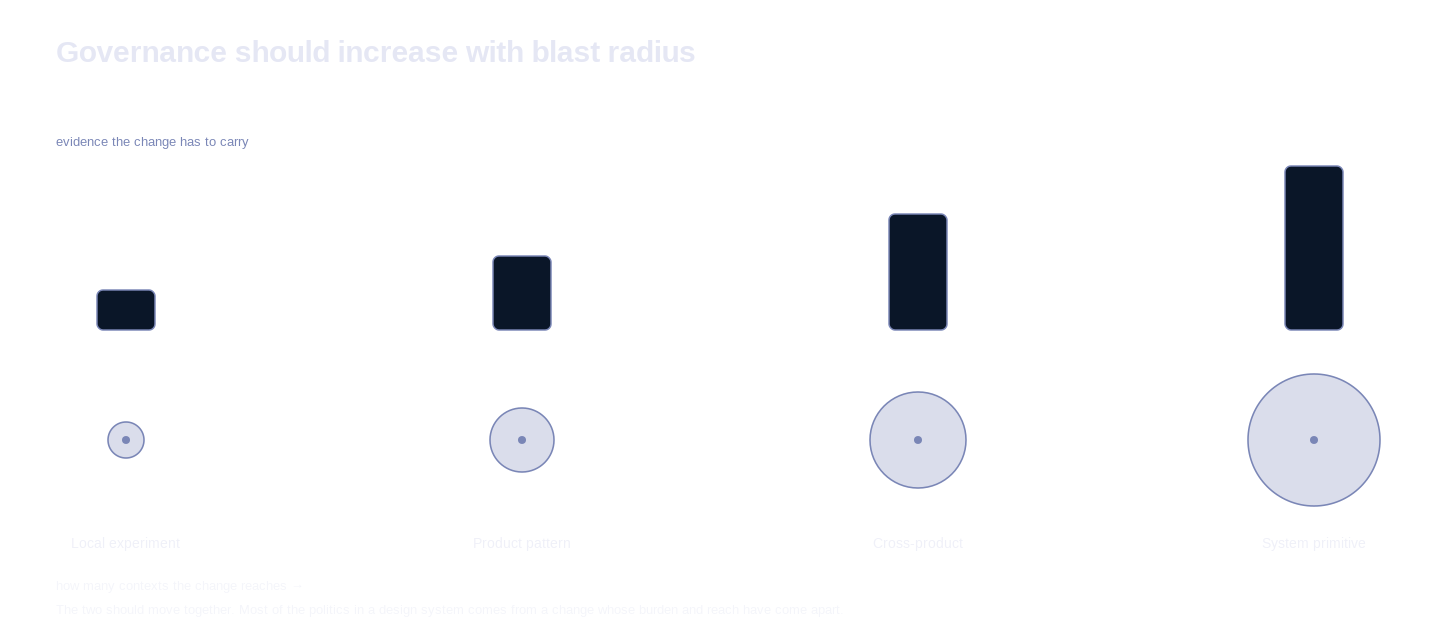
Changing a local component affects one context. Changing a component used by fifty products affects fifty contexts. Those decisions should not require the same level of evidence.
That sounds obvious when stated plainly. In practice, organisations frequently treat both directions badly.
Sometimes tiny local deviations require central approval. Elsewhere, major shared components enter the system because one influential team needed them quickly.
The process becomes political because the decision boundary has never been made explicit.
There is another path: let the pattern mature in the product
GitHub's Primer documents a particularly interesting route for new components. Its guidance describes an “on-ramp from product to Primer”: a component can first exist as a custom component inside a feature team's application and then move towards the shared system as it matures and gains broader usage.[2]
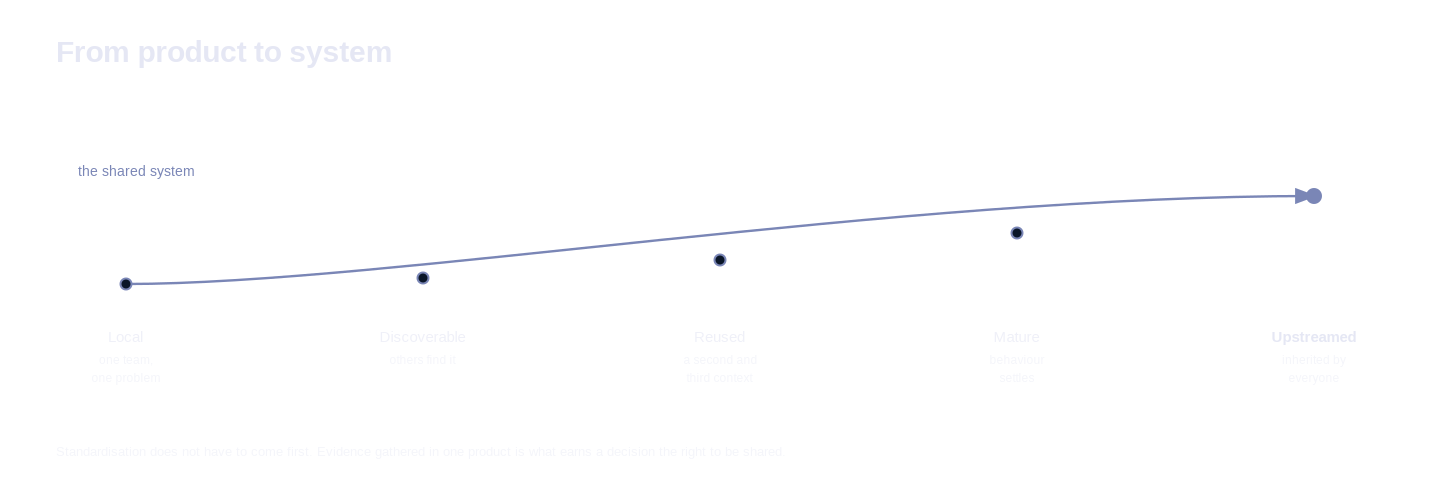
That reverses a common assumption. Not every potentially reusable component needs to begin its life as a system component.
Sometimes the responsible path is:
solve the specific problem, observe it, learn from actual usage, discover other contexts, then generalise.
Primer's wider contribution guidance also recognises several routes into the system, including discussions, pattern proposals, documentation changes, prototypes, testing and open-source contributions.[3]
The model differs from GOV.UK's. The underlying problem is the same.
How does a local decision acquire enough evidence and legitimacy to become shared infrastructure?
This is where “flexibility” gets dangerous
The natural compromise is to make the shared component flexible enough for everyone.
- Add a prop.
- Add another variant.
- Add a configuration.
- Add an override.
Eventually the component supports fifteen behaviours that were individually reasonable and collectively incomprehensible. This is a negotiation failure disguised as technical flexibility.
Instead of deciding which behaviours actually belong in the shared abstraction, the system stores every disagreement as configuration. The component becomes the fossil record of unresolved organisational decisions.
A mature system sometimes needs to say:
- That behaviour belongs here.
- That variation belongs locally.
- These two use cases are not actually the same component.
Or: We do not yet understand this problem well enough to standardise it.
Those are design decisions too.
The system needs a way to change its mind
There is another reason governance matters. Standardisation makes decisions durable. That is useful until the decision becomes wrong.
Technology changes. Platforms change. Accessibility guidance changes. Product expectations change. The organisation itself changes.
If introducing a shared decision requires evidence, retiring one should require deliberate work too. Otherwise the system accumulates rules that nobody still believes in, but everyone continues following because they are encoded in components.
The healthiest systems are not merely good at accepting contributions. They are good at renegotiating previous decisions.
Measure the quality of negotiation, not the size of the library
Component count tells us very little about system maturity. Even adoption is incomplete.
I would rather know:
- Can teams understand why a shared decision exists?
- Can they identify when their problem genuinely falls outside it?
- Can they propose a change without needing a personal relationship with the system team?
- Can local experimentation happen without fragmenting the entire product?
- Can repeated local patterns graduate into the shared system?
- Can obsolete shared decisions leave it?
Those questions tell us more about the health of the system than the size of its component catalogue.
Consistency is the result
Consistency matters. Users benefit when basic behaviours remain predictable. Engineers benefit from not rebuilding solved interactions. Designers gain time when foundational decisions do not have to be remade for every feature.
But consistency is not the most interesting thing the system creates. Consistency is what we see when enough teams agree to share enough decisions.
The deeper product of a mature design system is the mechanism by which those decisions can be adopted, questioned, improved and occasionally rejected.
That is why some of the hardest design-system conversations begin with five deceptively simple words:
“Our case is slightly different.”
Sometimes it isn't. Sometimes it genuinely is. The quality of the system depends on being able to tell the difference.