When a Product Constraint Becomes Part of the Interface
Technical limitations do not remain inside architecture diagrams. Eventually, the user meets them.
There are sentences every product designer eventually hears from an engineer.
- “We don't know until the request completes.”
- “That value can change while the user is here.”
- “We cannot update those independently.”
- “The provider has not responded yet.”
- “If they close this now, the changes have not reached the server.”
- “This process runs in the background.”
The sentence normally arrives as an explanation of how the system works. The interesting part comes afterwards.
What does the interface do with that information?
Because the moment a technical condition changes what the user can understand, trust or do next, it stops being purely an implementation detail.
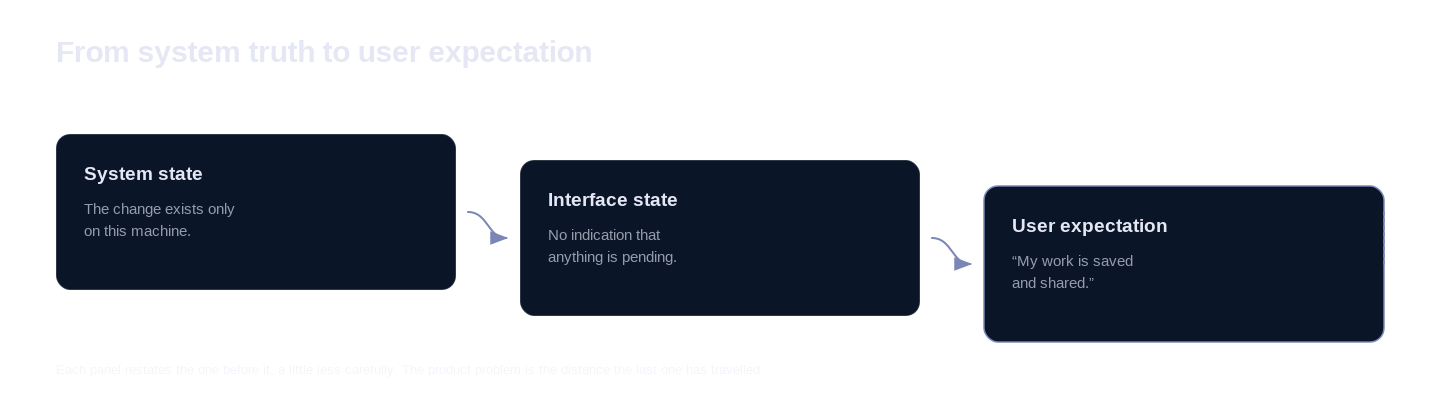
System truth and interface truth
Every interactive product is presenting a version of reality.
- The button says the file is saved.
- The price says the item costs €80.
- The progress indicator says something is processing.
- The green tick says the operation succeeded.
Behind those representations is another state: what the system actually knows. When those two states align, nobody notices. When they diverge, we get a product problem.
- A file looks saved but is still local.
- A product appears available but inventory has expired.
- An action appears finished but the job is still running.
- A filter looks applied while an older network request is actually controlling the results.
The useful design question is therefore not simply: What is the technical constraint?
It is: What does the interface currently imply that the system cannot guarantee?
Figma does not need to teach users about IndexedDB
Take losing an internet connection while working in Figma. The technical story is not simple.
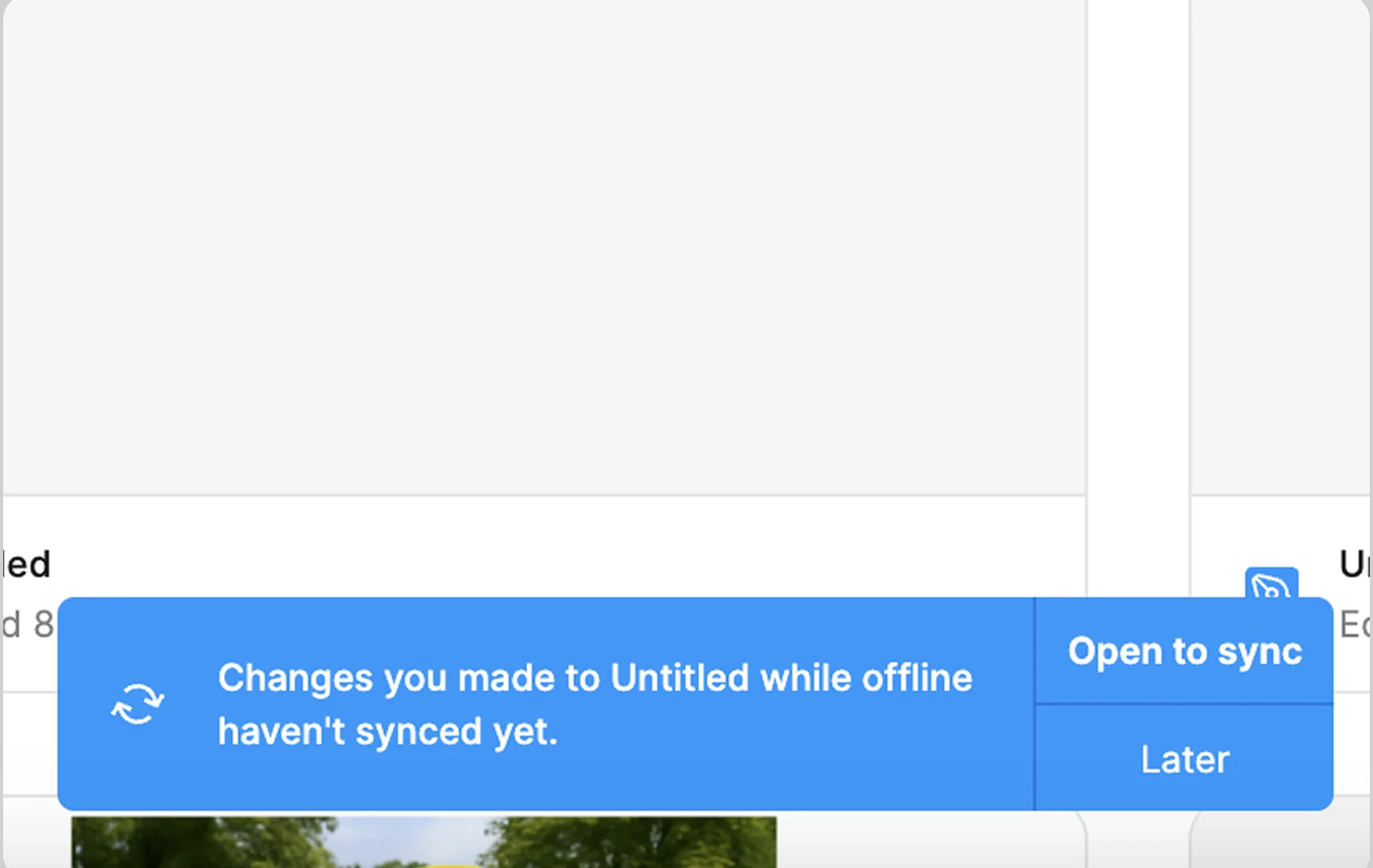
Figma is cloud-based. When connectivity disappears, the application can store changes locally in the browser and later synchronise them when the connection returns. Figma documents that it surfaces an offline indicator, an unsaved-changes notification and, where necessary, a flow for synchronising those offline edits later.[1]
The user does not need to understand the local persistence mechanism. They need to understand something much smaller:
Your latest work exists, but it has not reached the shared system yet.
That is the product translation.
I find it useful to think about technical constraints in three ways.
Some should remain completely concealed. Users do not need to know about every cache, request, replica or background service.
Some need to be translated. “Your changes haven't synced yet” is a translation of a technical state into a product state.
And occasionally the constraint needs to be explicitly exposed because understanding it changes the user's decision.
- “This price is no longer available.”
- “Results may be incomplete.”
- “This operation will continue after you leave.”
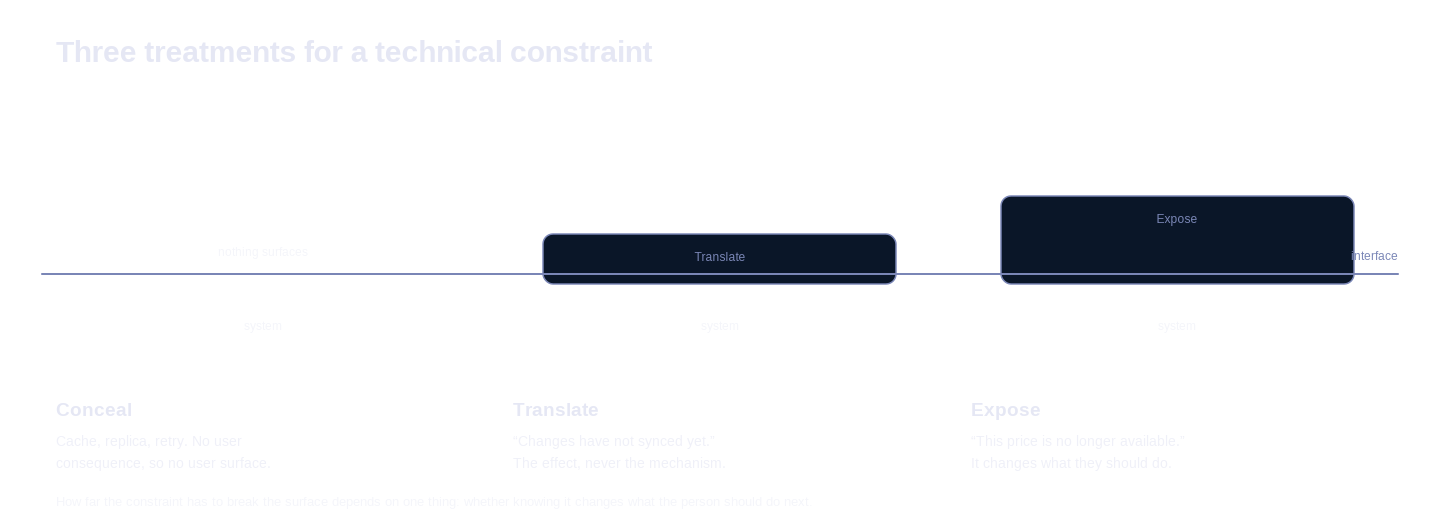
The challenge is knowing which treatment is appropriate.
A useful threshold
The question I keep returning to is:
Does understanding this constraint change what the user should do?
If the answer is no, the infrastructure should probably stay invisible. If the answer is yes, hiding it starts to become misleading.
That is where architecture enters the interaction.
A loading spinner can hide too much
Consider a process containing several dependent operations. A spinner communicates that something has not finished. It communicates almost nothing about why.
For a simple operation that may be enough. For a system where dependency matters, it can be inadequate.
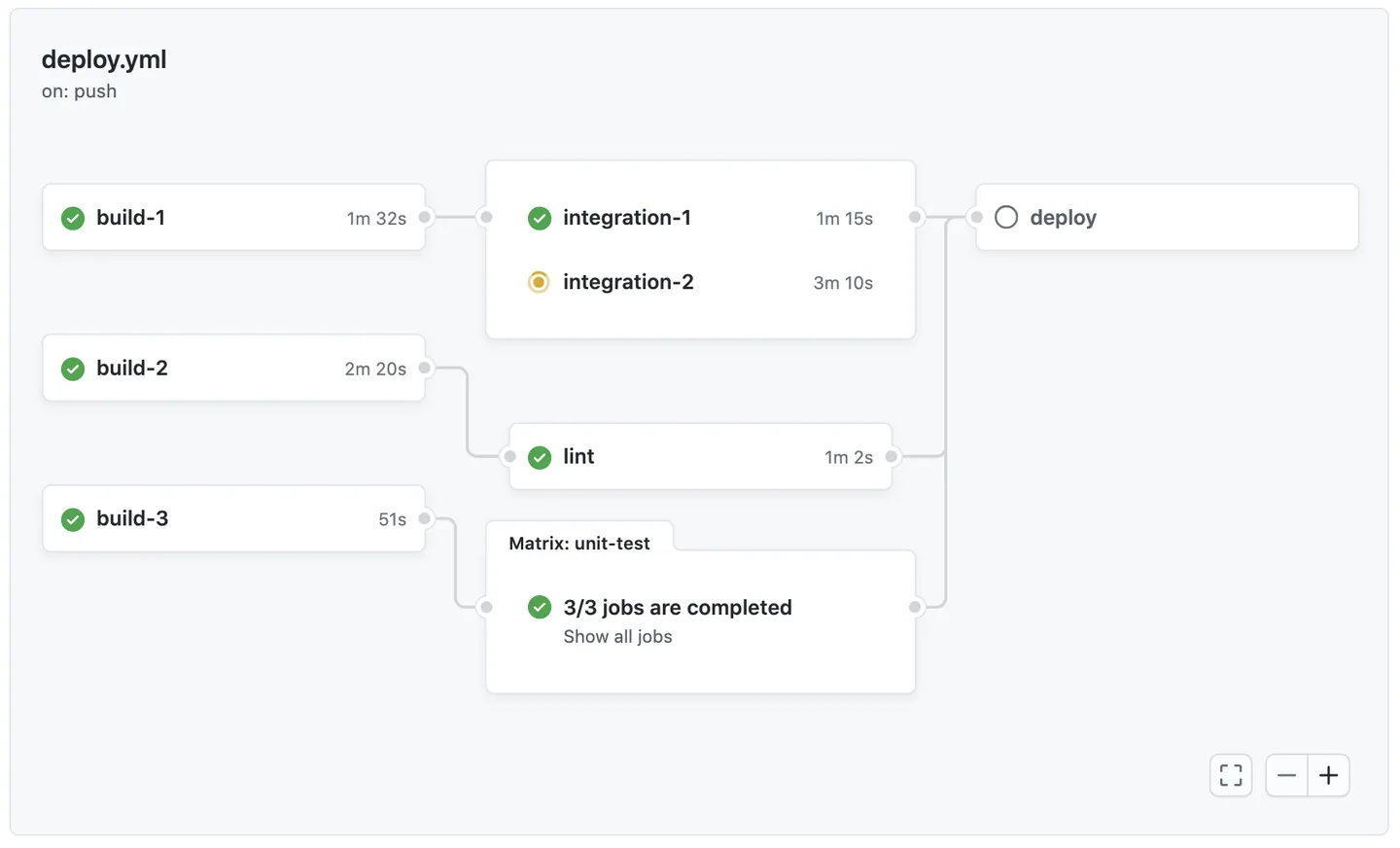
GitHub Actions handles this differently. Every workflow run can generate a real-time visualisation graph. Jobs appear with their individual statuses, while lines show dependencies between them.[2]
Here the structure of the system becomes part of the interface because the structure is useful.
A developer may need to know that deployment is not simply “slow”. It is waiting because another job has not completed.
Those are very different explanations.
Latency changes more than speed
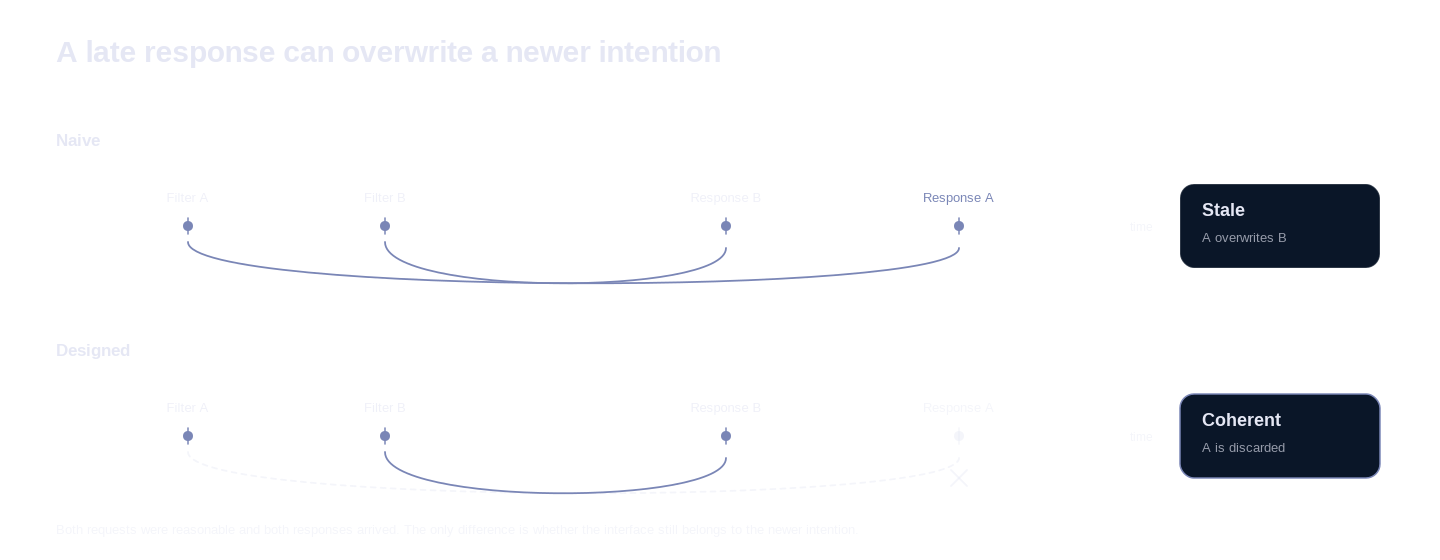
Suppose a filter applies remotely and takes three seconds to return. It is easy to treat this as a performance problem. Then the interaction begins.
- Can the user select another filter while the first request is running?
- If they do, which response wins?
- Can responses arrive out of sequence?
- Is the displayed result count associated with the old state or the new one?
- Do we optimistically update the control before the backend confirms it?
- What happens when the request fails?
The delay has now affected causality. It changes whether someone can understand which action produced the state they are seeing. A spinner cannot solve that on its own.
The real design problem is state coherence.
Product truth has a cost
Products naturally want to appear fast, stable and simple. That instinct is healthy until simplicity starts creating false certainty.
- The price changes at the final step.
- The upload looked finished but was not.
- The supposedly saved change disappears.
- The result count describes an earlier query.
Each mismatch asks the user to revise their understanding of what the interface means. One mismatch is normally survivable. Repeated mismatches teach people not to trust the product's representations.
There is an important distinction here. Good design hides irrelevant implementation complexity. Good design should not hide relevant uncertainty.
Constraints can produce the interaction rather than merely damage it
This is also why I do not think constraints should always be framed as compromises.
- Offline behaviour forces us to think seriously about local and remote state.
- Long-running operations force us to design asynchronous workflows.
- Changing inventory forces us to think about freshness.
- Platform differences force us to reconsider how an interaction should behave rather than blindly reproduce another platform.
Sometimes the wrong question is:
How do we preserve the design despite this constraint?
A better question is:
What interaction becomes appropriate because this constraint exists?
That change in framing is small. But it often produces a more truthful product.
When infrastructure becomes UX
When a technical limitation appears, I use four questions.
- What does the system actually know?
- What does the interface currently claim?
- What does the user therefore believe?
- Would the difference change their next decision?
If the last answer is yes, we are no longer discussing an implementation detail. The infrastructure has entered the experience.