When the Interface Starts Acting on Your Behalf
AI introduces a design problem software has rarely had to confront at this scale: delegated authority.
You ask an assistant to find somewhere for dinner. It researches restaurants and gives you three suggestions. Useful.
Now give it access to your calendar. It excludes the nights when you are busy. More useful.
Now give it the ability to make reservations. The interaction has changed.
The question is no longer only whether the system understood what you meant. The system can now create consequences.
What exactly did you authorise?
Generation is easier to reason about than action
Much of the first generation of AI product interaction has revolved around outputs.
- Generate some text.
- Summarise a document.
- Create an image.
- Suggest code.
- Answer a question.
In each case, there is a natural boundary. The system produces something. The human chooses what happens next.
Agents weaken that boundary. A system can research, navigate, modify information, invoke tools and interact with external services.
Now the answer to a prompt may not be another artefact. It may be a changed state somewhere else.
- An email sent.
- A meeting moved.
- A pull request opened.
- A file edited.
- A purchase prepared.
The central design problem therefore moves from: What can the model produce?
towards: What is the system authorised to change?
Access and authority are different things
This distinction becomes clearer in current agentic products.
ChatGPT Work's cloud browser can interact with supported websites, including clicking buttons, entering information and working inside signed-in experiences.
Its current product guidance explicitly separates permission to access a website from approval for a consequential action. Allowing access to a site does not remove the need to confirm actions that can be hard to reverse or create significant financial, legal, account or other real-world commitments, such as confirming a booking or making a payment.[1]
That distinction is more important than it first appears.
Access answers: Can the system enter this environment?
Authority answers: What may it do once it is there?
Those are completely different permissions.
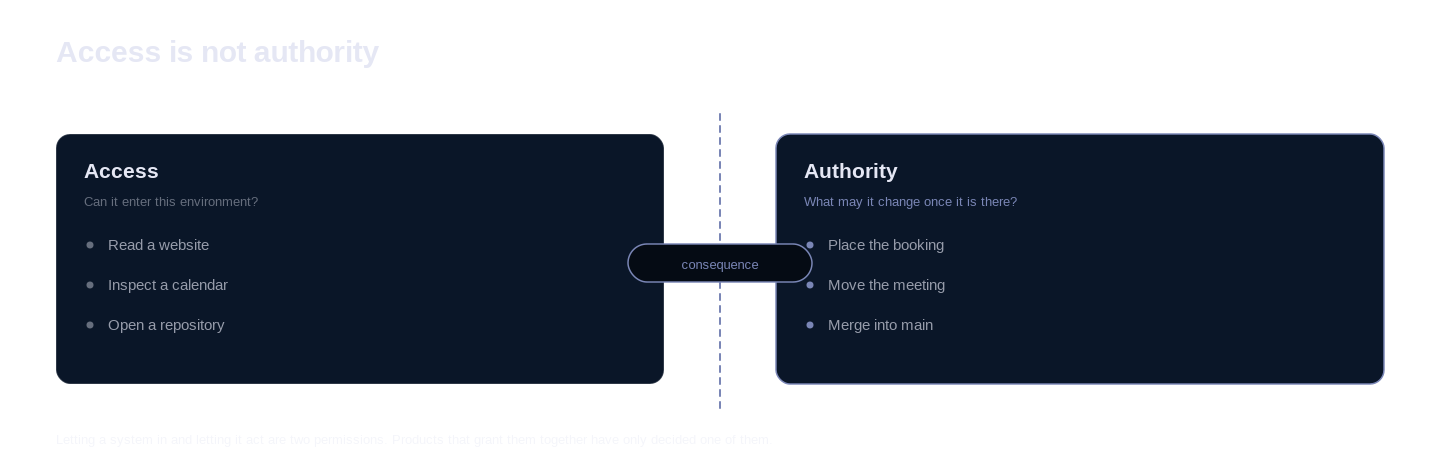
This difference existed before AI, but agents make it central. A calendar application may have permission to edit events. That does not automatically answer whether an agent should reschedule a client meeting because it inferred that another time was more convenient.
Technical capability does not define legitimate delegation.
Delegation needs boundaries
When people delegate tasks to other people, they rarely delegate infinite authority.
“Find somewhere for dinner” is an objective.
“Find somewhere for dinner within twenty minutes of the hotel, under €80 per person. You can reserve it, but ask me before anything with a cancellation charge.” is something else.
It contains a small authority model.
Goal. Scope. Constraint. Threshold. Escalation condition.
AI interfaces need ways of representing the same thing. Not necessarily as a formal settings panel. But the system has to know where delegated authority stops.
I think of that boundary as the delegation contract.
The contract answers:
- What outcome is the agent pursuing?
- What resources can it use?
- What actions can it perform?
- What constraints apply?
- What requires approval?
- What should happen outside the agreed boundary?
- How can the person stop or reverse it?
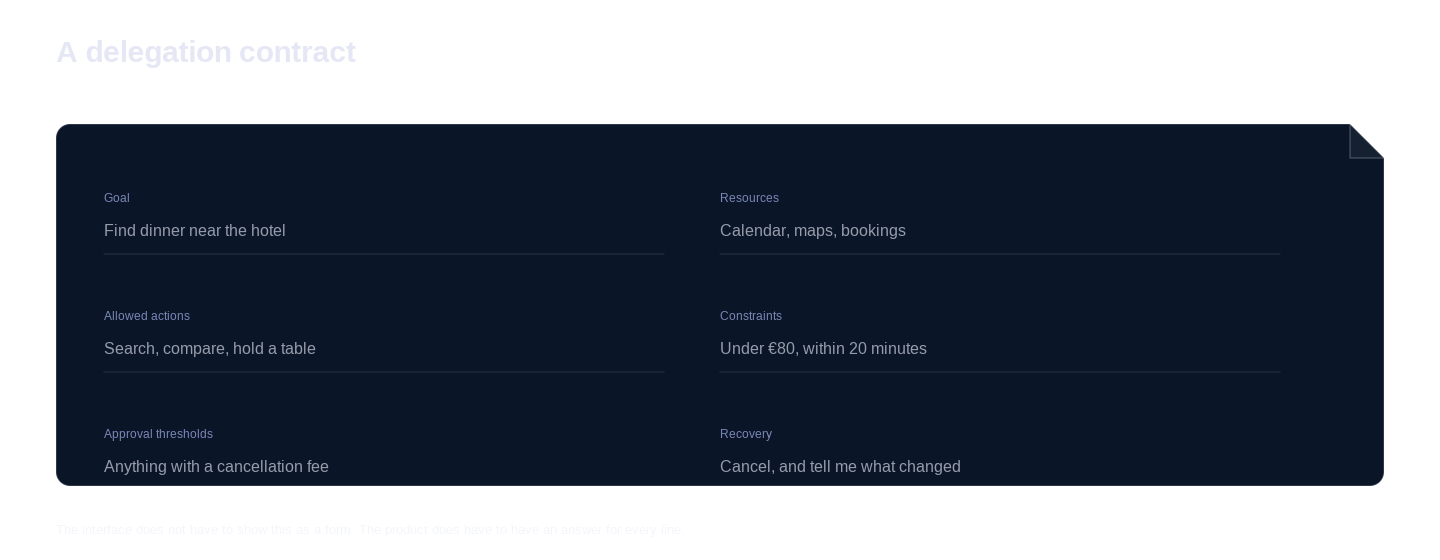
If the answers are unclear to the user, the agent may be capable without being trustworthy.
GitHub makes the boundary visible through the pull request
Consider GitHub Copilot's cloud agent. GitHub documents a workflow where the agent can work autonomously on an issue or developer request and raise a draft pull request. Its default guardrails restrict the agent from merging that pull request itself and require human review before merge.[2][3]
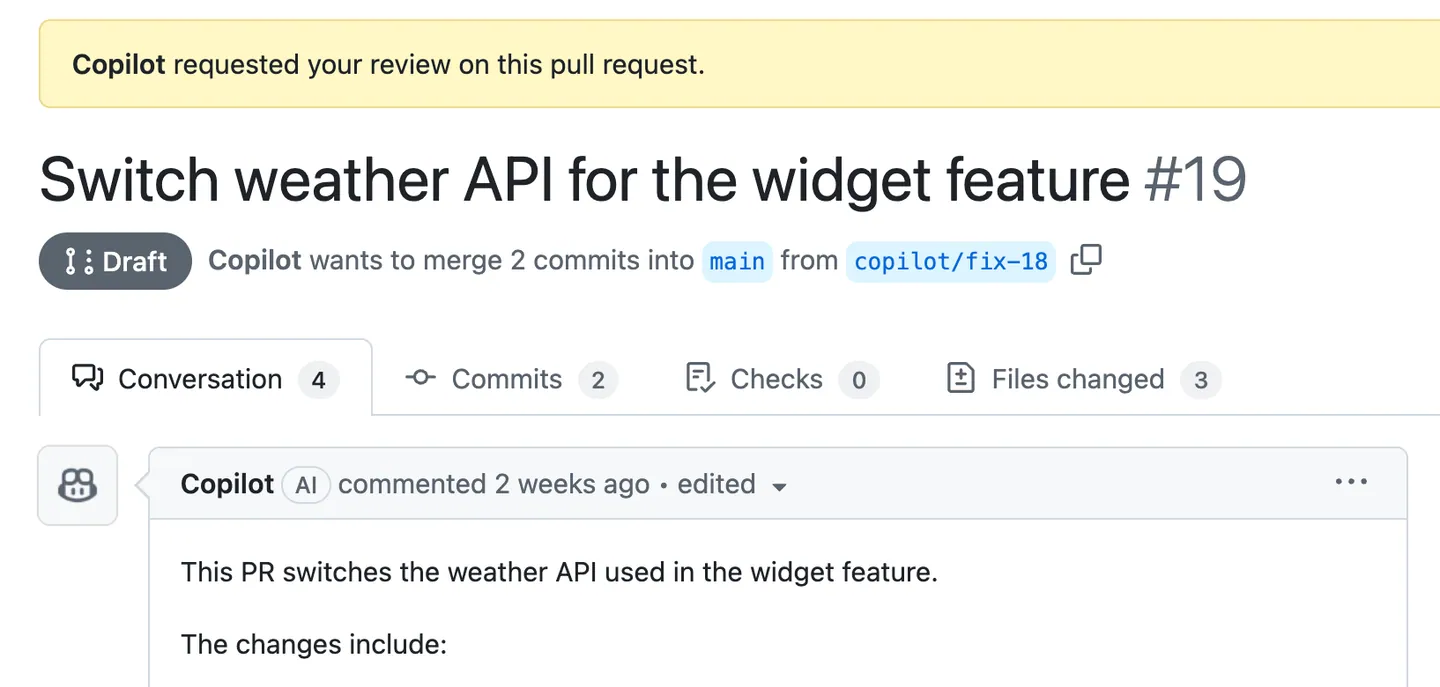
This is not just an engineering workflow. It is an authority boundary embodied in an existing product primitive.
The agent is allowed to:
investigate, change code, prepare a proposal, respond to feedback.
But the pull request creates a checkpoint before those changes become part of the shared codebase.
The important interface element is not the AI icon. It is the boundary between prepared action and committed action.
GitHub also now exposes more explicit agent-merge workflows in some Copilot experiences. Those workflows remain bounded by repository rules, checks and approvals, which is useful precisely because it shows that “more autonomy” is not one switch. It is a set of permissions layered onto existing governance.[4]
We need more than an “autonomous / not autonomous” switch
AI products are often discussed as though autonomy is one variable. It is more useful to treat it as a gradient.
A system can observe. It can recommend. It can prepare. It can execute. It can commit.
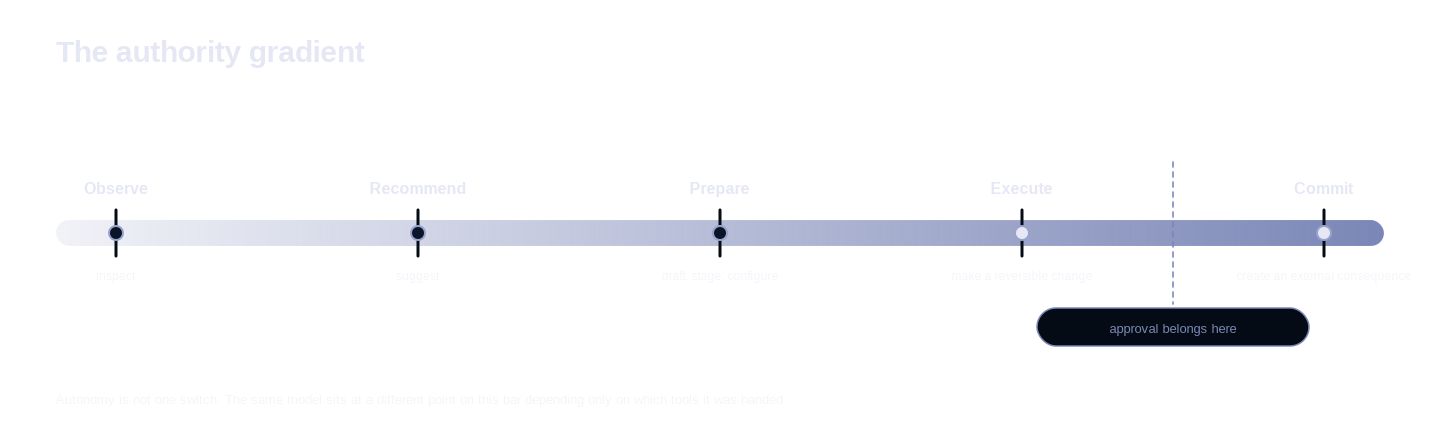
These levels are not determined by intelligence. They are determined by product permissions and interaction design. The exact same model can occupy completely different positions depending on the tools it receives.
A travel assistant that compares flights is not the same product as one that can purchase the ticket. A coding agent that prepares a patch is not the same product as one that can deploy production code. A financial assistant that explains transactions is not the same product as one that can initiate them.
Confirmation everywhere would defeat the point
There is an obvious solution to the authority problem. Ask before every action.
- May I search?
- May I open this file?
- May I edit it?
- May I save?
- May I continue?
The system is now safe partly because it is barely delegated.
The opposite approach is complete autonomy. That works until the agent confidently makes the wrong consequential decision.
The design problem is therefore not whether people remain “in the loop” in some abstract sense. It is where the loop closes.
Approval belongs where the consequence changes.
- Reading a calendar is not the same as deleting an appointment.
- Finding flights is not the same as purchasing one.
- Editing a local branch is not the same as merging it into shared code.
- Drafting a message is not the same as sending it to 200 people.
This suggests a more practical rule:
Ask for intervention when an action crosses a meaningful consequence boundary, not merely because the agent performed another step.
Reversibility changes how much autonomy is reasonable
There is another variable: what happens when the system is wrong. Consider two agent actions.
The first reorganises a private draft. The second permanently deletes a shared customer record.
Even if the probability of error were identical, these actions should not inherit identical authority. One is cheap to reverse. The other is not.
The interface should therefore understand not only what action is happening, but also the cost of recovering from it.
This is one reason familiar product primitives such as drafts, pull requests, version history, staged changes and confirmation boundaries become newly important in agentic products. They create places where automation can do substantial work without immediately creating irreversible consequences.
The agent also needs an understandable history
As workflows become longer, another interface problem appears. What exactly did the system do?
A conventional interaction often leaves obvious traces.
The message appears in Sent. The file gets a version. The transaction appears in history.
An agent can coordinate several services and perform several actions before returning. The end result alone may not explain the process.
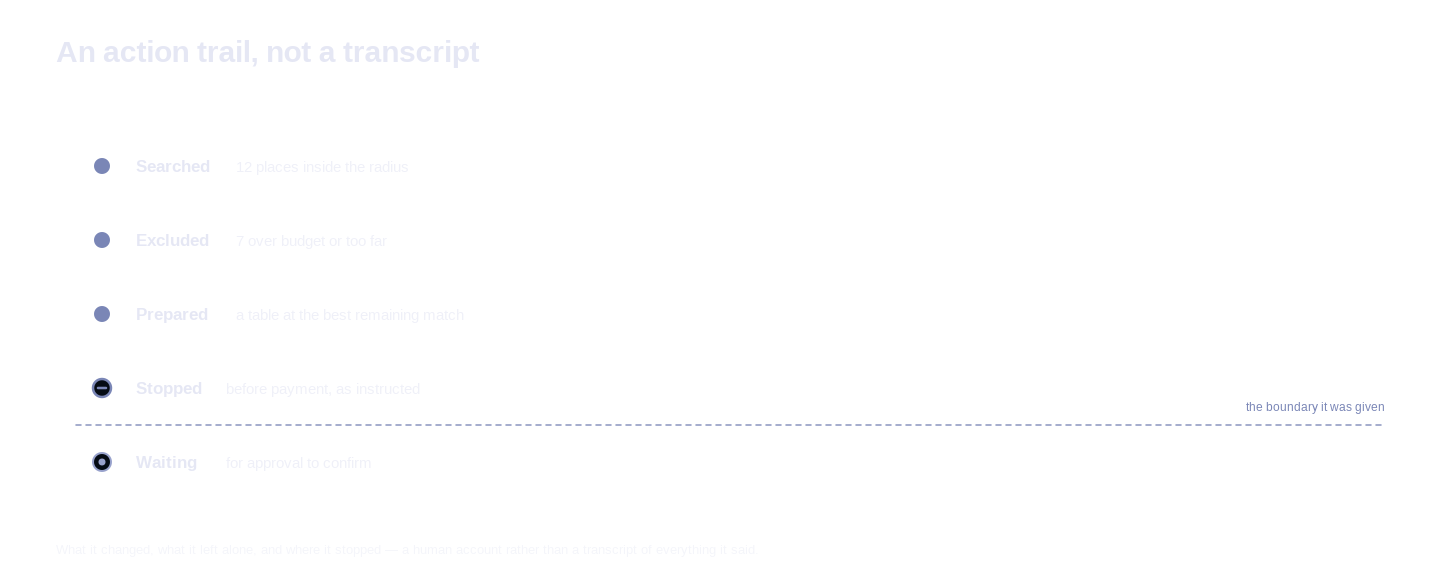
That means agentic products increasingly need an action trail rather than simply a conversation transcript. Not internal debugging output.
A useful human account:
- What did you change?
- Where?
- Why?
- What failed?
- What did you leave untouched?
- What still requires me?
Trust may depend less on personality than boundaries
A large amount of attention in AI design goes into whether an assistant feels conversational, natural or human. Those things matter. But for systems that act, I suspect trust will increasingly come from something more mundane.
Predictability.
- Does the agent stay within the task I delegated?
- Does it recognise when circumstances have changed?
- Does it stop at the right moments?
- Can I inspect what happened?
- Can I undo what it did?
- Does it distinguish access from authority?
Those properties are not visual polish surrounding the AI. They are the product.
We are beginning to design authority
For decades, interface design has largely focused on giving people controls for telling software what to do. Agentic systems introduce the inverse problem.
We now also need controls for telling software what it is allowed to do without us.
Scopes. Limits. Budgets. Approval thresholds. Exceptions. Reversible actions. Stop controls. Action histories.
These may look less exciting than a conversational interface. But they define the relationship.
Once software can act on our behalf, the most important question is no longer only: What can this system do?
It becomes: What have I actually entrusted it to do?
References
- OpenAI Help Centre, “Using cloud browser in ChatGPT”. Source
- GitHub Docs, “Risks and mitigations for GitHub Copilot cloud agent”. Source
- GitHub Docs, “Integrating agentic AI into your enterprise's software development lifecycle”. Source
- GitHub Docs, “Managing issues and pull requests with the GitHub Copilot app”. Source