Building Andela's searchable talent taxonomy.
How I created a shared language for engineering skills that became the foundation for Andela Talent Search.
We quickly realised the main challenge was many documents scattered across Docs, Sheets & Slides, maintained by different teams. We needed to harmonise this.
- SlidesFor developer profiles
- SheetsFor sales & staffing data
- Bamboo HRFor HR data (leave days)
- HackerrankFor engineer assessments
- GreenhouseFor hiring
- LookerFor data sync
- Role
- Product Designer
- Company
- Andela
- Period
- 2020
- Scope
- Talent taxonomy, information architecture, taxonomy search, supply insights and governance
- Collaborators
- Product, data, staffing, sales and product-engineering teams
The right engineer could exist in the network and still be hard to find.
Andela's marketplace depended on connecting companies with the right engineering talent at the right time. The organisation already held information about skills, experience, availability and previous work, but that information lived across spreadsheets, presentation files, HR platforms and assessment systems.
Staffing specialists used manually maintained records, sales teams needed visibility into available supply, and engineers needed a consistent way to represent their capabilities. People with institutional knowledge became the integration layer between fragmented tools.
Fragmented terminology created operational uncertainty.
A polished search interface on top of inconsistent data would only return unreliable results faster.
The same capability could be recorded under different spellings, abbreviations or categories. Similar technologies were not always connected. A skill could exist without enough context to distinguish familiarity from professional experience.
This made supply hard to understand, limited sales visibility, weakened learning and recruiting signals and made future matching products less dependable.
Understanding how teams interpreted talent data.
The wider Talent Network programme included a survey of 532 engineers. I also took part in focused research and design-sprint sessions with staffing specialists, sales executives, product managers, data specialists, product engineers and engineers represented within the network.
Each group had different goals, but they depended on the same underlying information. The opportunity was to define that information once and make it reusable across business workflows.
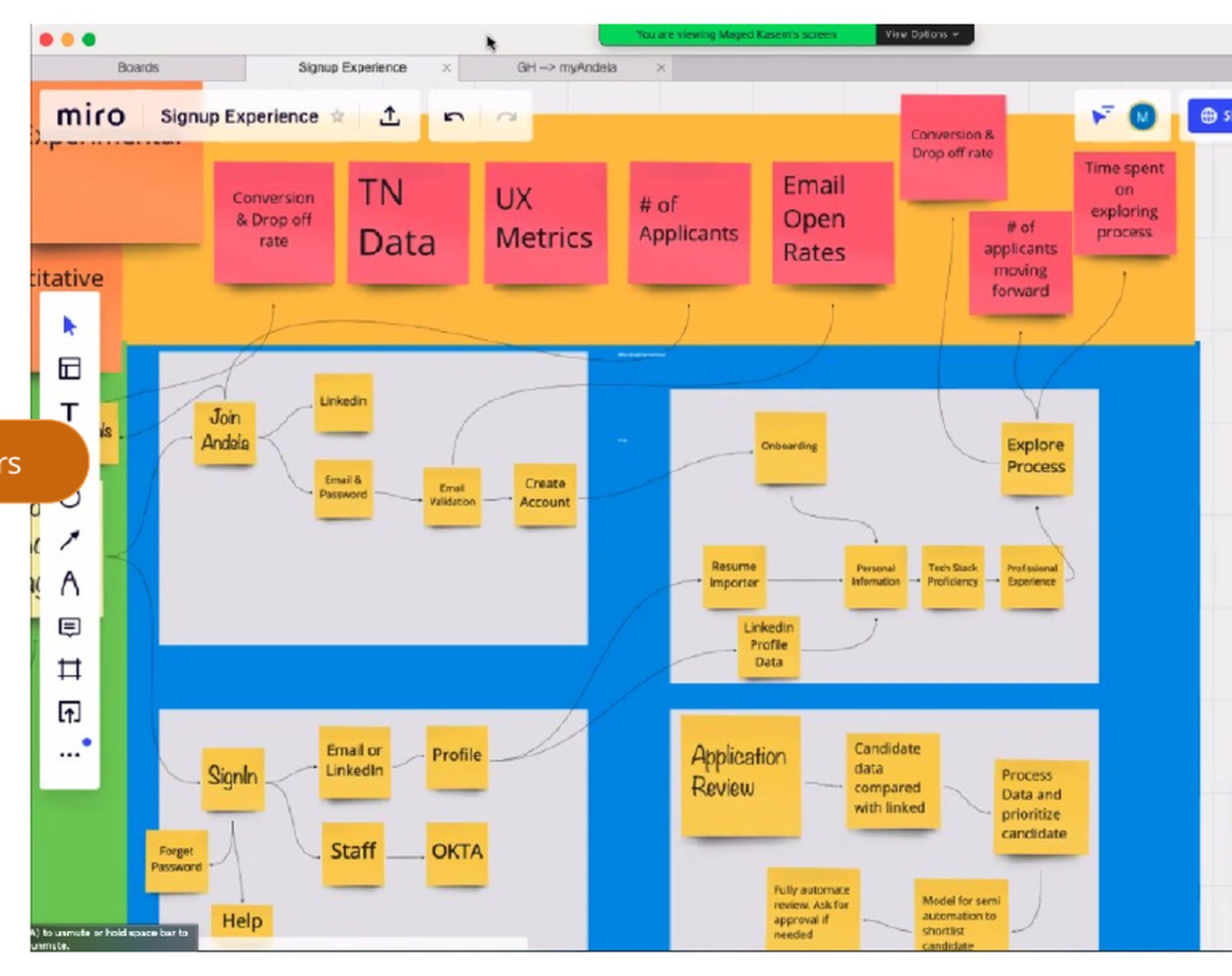
Creating a structure for a changing technical landscape.
We reframed the work around a foundational question: how might we create a consistent and extensible language for describing engineering talent, then make that language useful across staffing, sales and product workflows?
The data team led the underlying data model. I made that model understandable and usable, defining the product experience around skills, programming languages, frameworks, tools, platforms, specialisations, hierarchy, relationships, metadata and supply information.
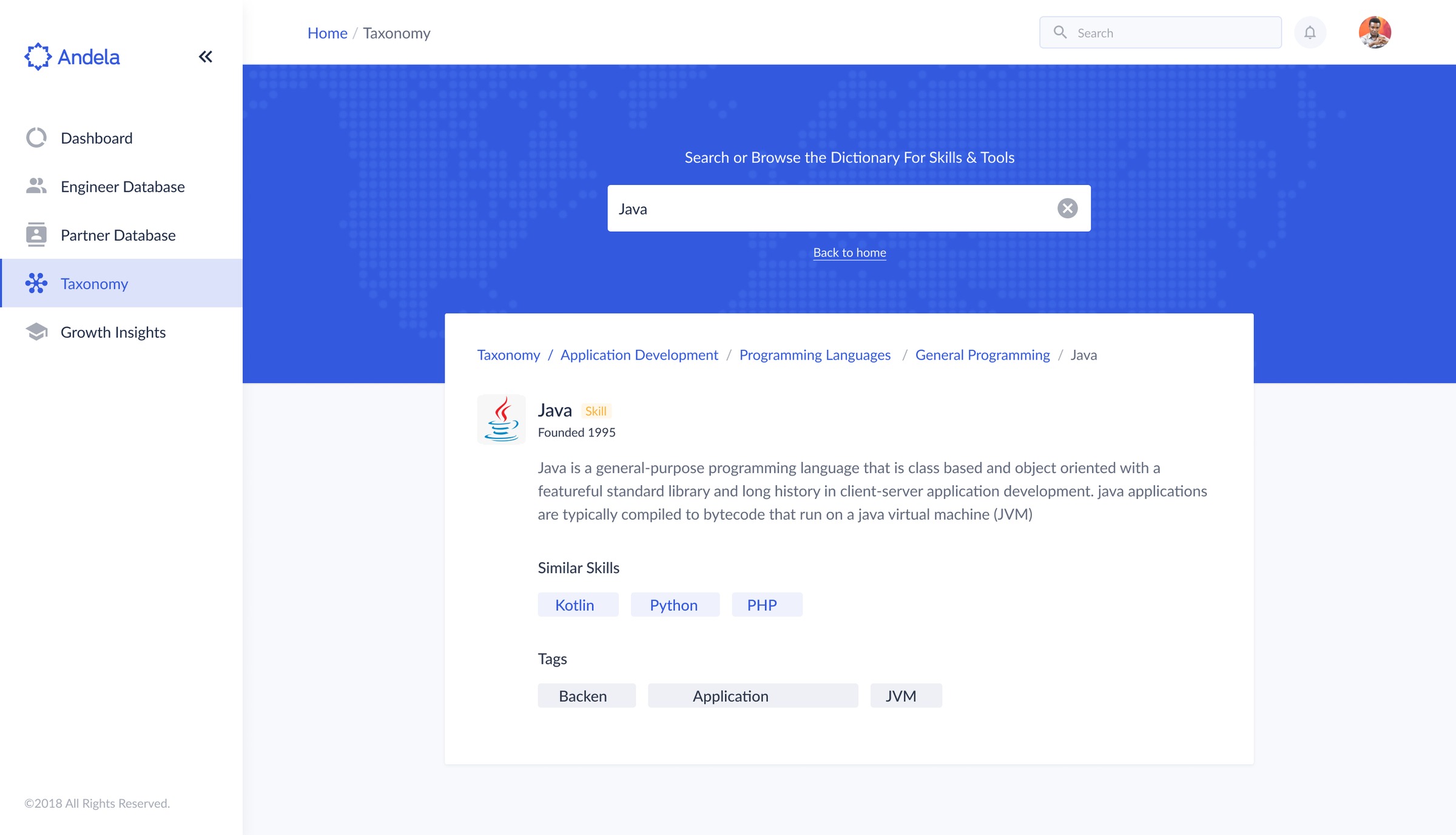
I designed the experience around search, explore and suggest.
Three core behaviours carried the taxonomy experience.
- Search
Users could locate known skills, tools or related technical concepts and return to recent searches for repeated operational tasks.
- Explore
Users could navigate parent, child, sibling and related concepts instead of treating each term as an isolated record.
- Suggest
Users could propose missing structured data for review without directly editing the canonical dictionary.
Testing showed that orientation mattered most.
We tested whether users could locate a specific skill, understand the result, move through relationships and propose missing information. The strongest issues were not visual-design issues. They were orientation issues.
The model could be logically correct and still feel difficult for non-specialists to navigate. I introduced clearer breadcrumbs, hierarchy, nesting, entity labels, relationships and routes back to the taxonomy home so users could build a mental model of the structure.
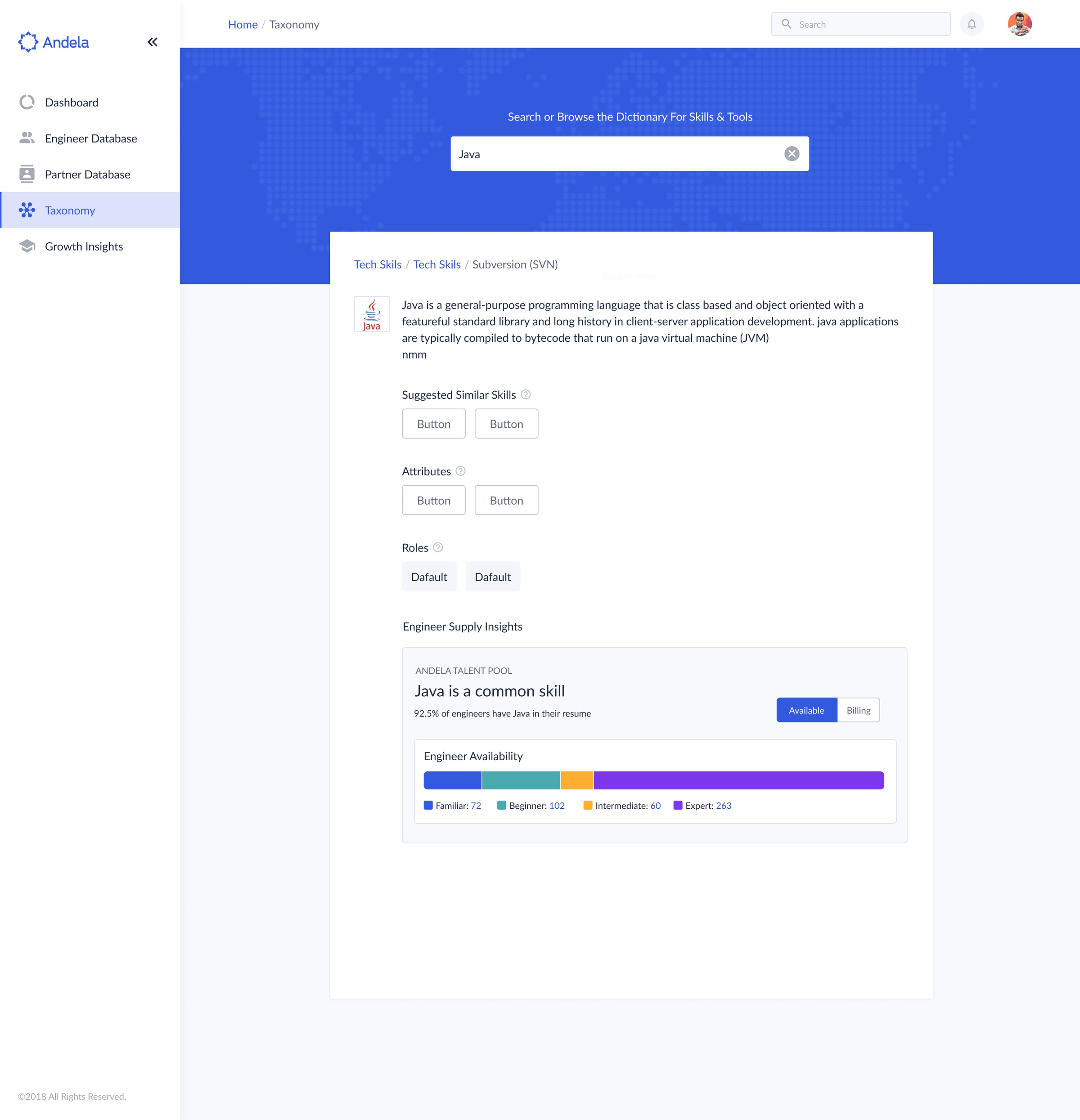
Shared language made supply measurable.
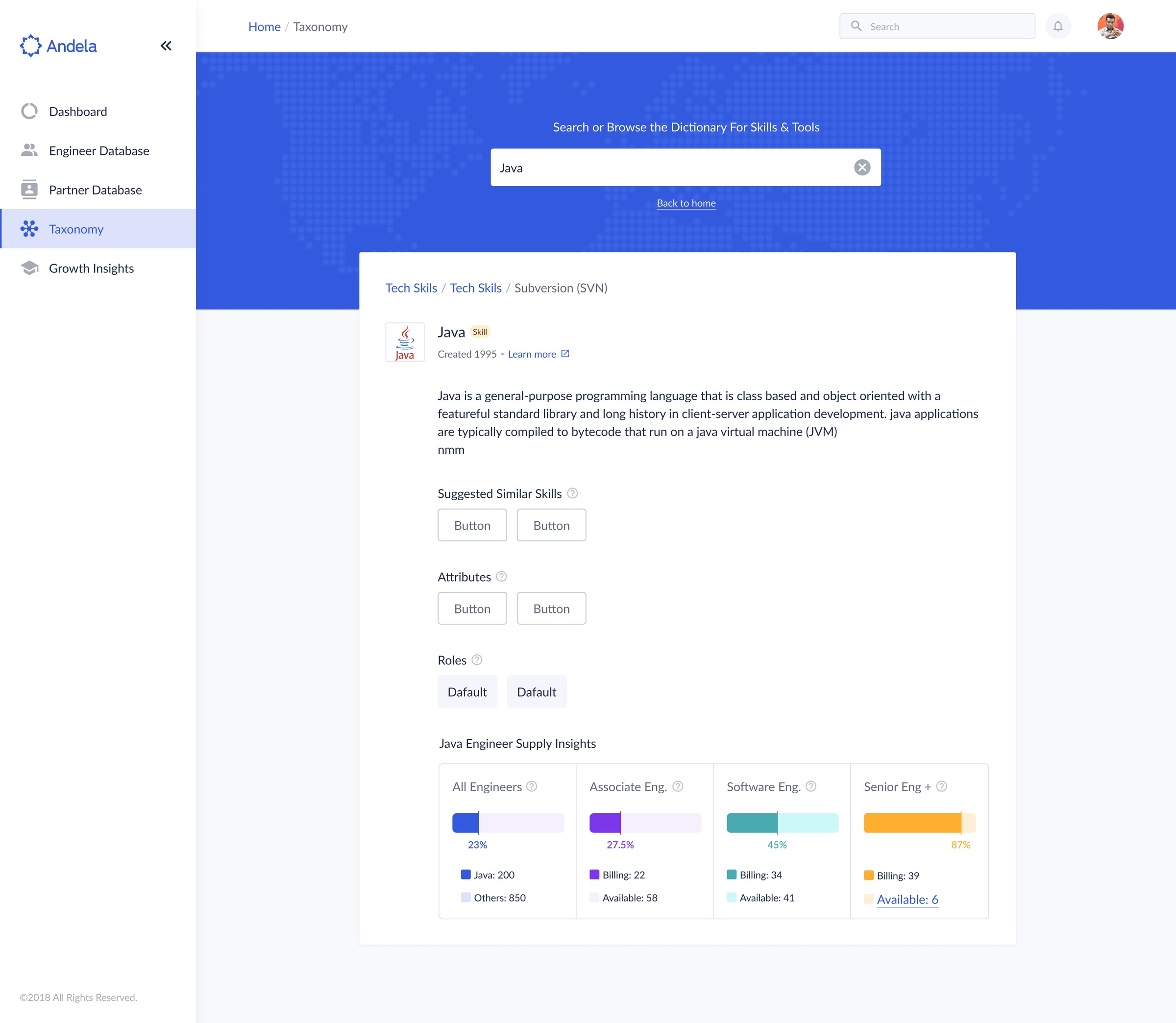
A definition says what a capability is. Staffing and sales needed to know who has it, how well, and whether they are free. With supply insights, I attached that view to every taxonomy entry.
Before it, a question like how many senior engineers in a given language could start next month was assembled by hand from exported records and reconciled spellings. Answers were slow, and two people could reach different numbers.
Each entry then resolved to a population rather than a description: distribution across familiar, beginner, intermediate and expert, with a toggle between available and billing engineers. A capability can look abundant and still be unavailable, because the strongest people are already committed.
This depended entirely on the taxonomy. Counting engineers per skill is straightforward once every record points at one canonical entry, and impossible while the same capability exists under several spellings.
Governance was part of the product.
Technology terminology changes continuously. Unrestricted editing would recreate the duplication the taxonomy was designed to solve, but a closed dictionary would quickly become stale.
I designed the contribution model to let users suggest missing information while the data team retained responsibility for approval, duplicate prevention, data quality and taxonomy maintenance. The goal was to reduce the human effort required to find and reconcile data before expert judgement could be applied.
- UsersSuggest missing information for review
- The data teamApproval, duplicate prevention, data quality
- The canonical dictionaryMaintained, and never edited directly
The foundation for Andela Talent Search.
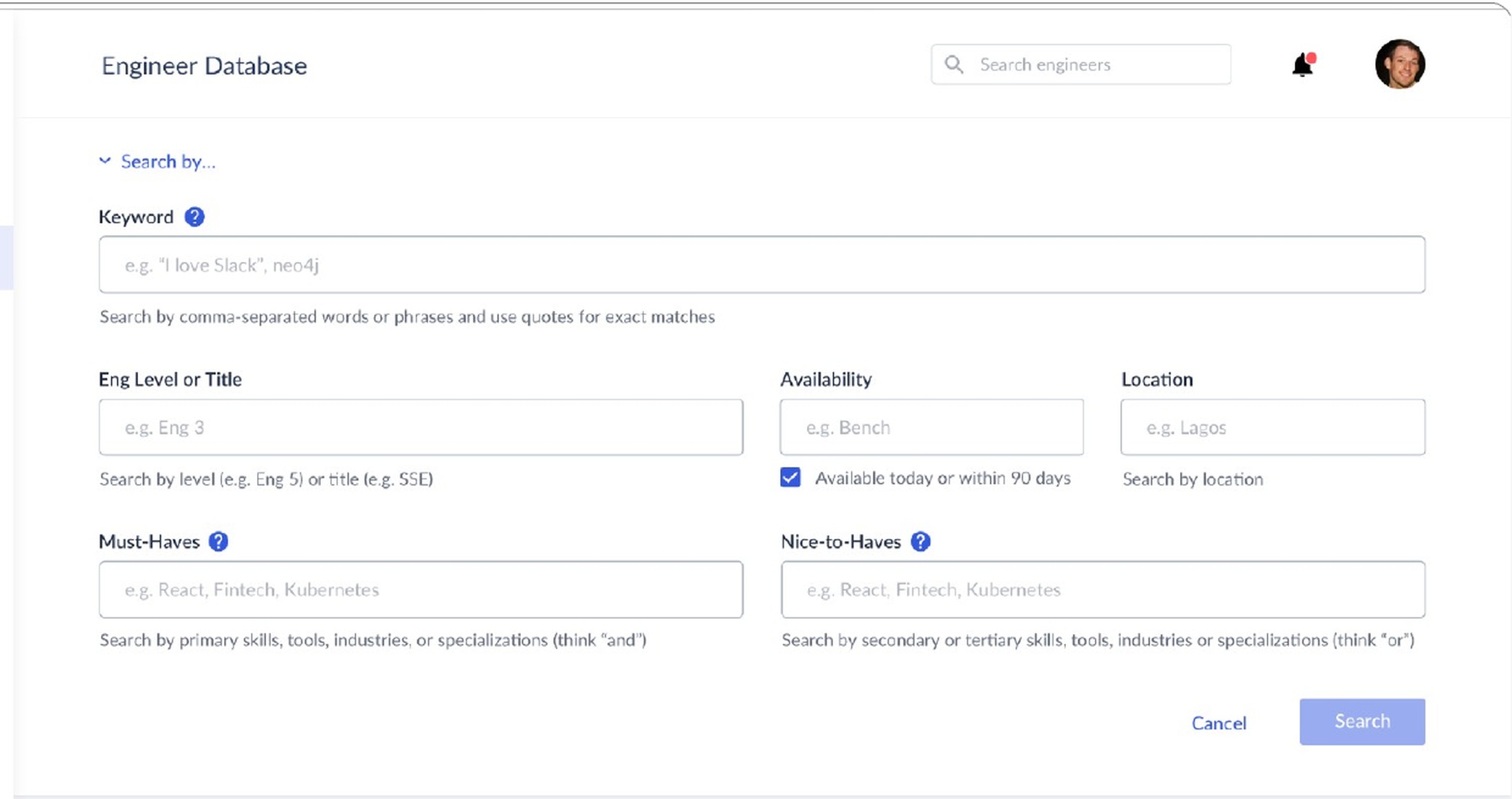
With a canonical vocabulary in place, a later search product could compare client requirements with engineer records more reliably across primary skills, supporting skills, availability, staffing status, experience level, location constraints and certifications.
The taxonomy went on to support sales, hiring and business intelligence, and opened an API that served supply insights.
This project
The taxonomy
Defined the shared language and stable identifiers.
A separate, later product
Andela Talent Search
Later applied that language to staffing decisions.
The taxonomy and Andela Talent Search were connected, but they were not the same product.
Reflection
This project reinforced that search quality begins with information quality. A discovery interface cannot compensate for inconsistent terminology, weak hierarchy or unclear governance.
The durable value was foundational: shared language, reusable talent data and clearer boundaries between system coordination and human judgement.
Before a talent marketplace can match people intelligently, it needs a shared and dependable language for describing talent.