Designing Andela's talent onboarding operating model.
How I enabled a global talent marketplace to move from manual candidate coordination to a clearer, faster, technology-enabled path into the Talent Network.




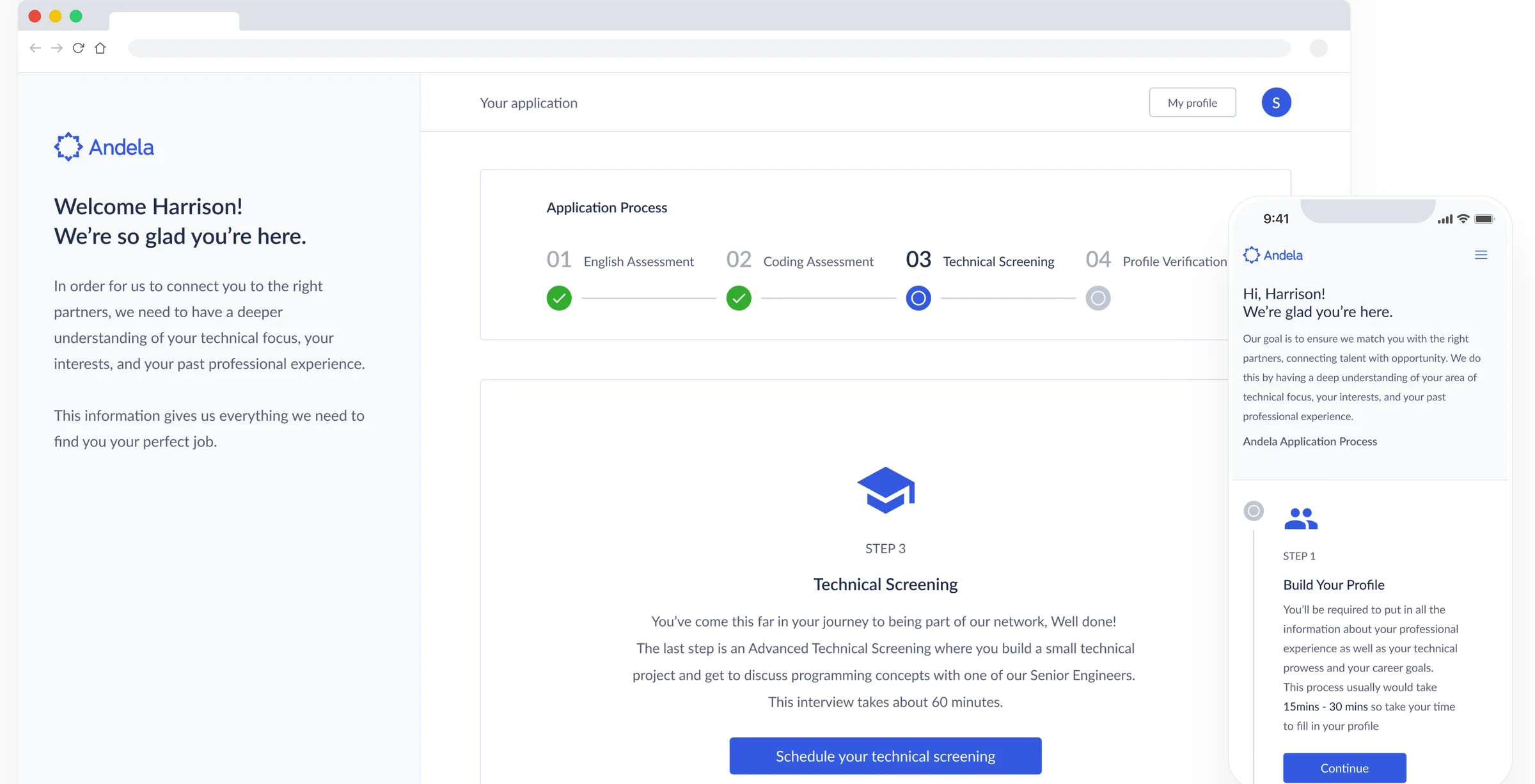
The applicant's assessment page, on desktop and on a phone: four stages, two done, the next one explained.
- Role
- Lead Product Designer
- Company
- Andela
- Period
- 2020–2021
- Delivery
- Eight-week MVP window
- Systems
- SurveyMonkey, Greenhouse, Codility and Salesforce
- Worked with
- Recruiters, talent operations, assessment specialists, product, engineering, and staffing and sales stakeholders
Andela is a talent marketplace, not a conventional hiring funnel.
Andela connects skilled technologists with companies that need engineering capacity. Its Talent Network is the supply side of that marketplace: people need to be discovered, assessed, verified, profiled and made ready for relevant client opportunities.
That means onboarding is not simply account creation. It is a business-critical readiness system. If it is too slow, qualified people wait outside the marketplace. If it is too loose, sales and staffing teams cannot trust the talent signal. If it depends on manual coordination, scale creates more operational drag instead of more ready-to-match talent.
Three sides of the same system
I had to design for candidates, the marketplace and the operations teams holding it together.
- Candidate side
- Technologists needed a clear path from application to assessment, profile readiness and Talent Network entry.
- Marketplace side
- Staffing and sales teams needed reliable, searchable, verified talent information to match people to client demand.
- Operations side
- Recruiters and talent operations needed less repetitive coordination and clearer exception-handling points.
The brief was speed, but the real constraint was operating design.
The target was to move qualified applicants into the Talent Network within 30 days without lowering the assessment standard.
The previous workflow took 90 to 120 days or more, three to four times the target. At first glance, that looked like a candidate-experience problem: too many steps, too much waiting, unclear progress. But in discovery I found the delay was systemic.
Before
90–120+ days
from application to the Talent Network, against a target of under 30.
What that meant for the business
- Clients lost to the wait. Clients with unique requirements were lost because sourcing took so long.
- Slow even on the fast track. Processing took a long time even for fast-tracked candidates.
- Overhead with every applicant. Manual effort at each step made operations the cost of growth.
- Candidates in the dark. Applicants did not know how long the process would take or what to do next.
- SurveyMonkeyApplication
- GreenhouseManually created records
- External assessment toolsAssessment
- SalesforceOperational follow-up
People were not just reviewing candidates; they were keeping the workflow alive by copying, checking, nudging and reconciling data between tools.
The programme, end to end
The programme moved through discovery, research, audit, scoping, design, implementation support and beta launch, and I had to hold operational alignment throughout.
- Problem identification
- Blue skies
- Research & analytics
- Audit & synthesis
- Scoping & v1 mapping
- Design
- Implementation support
- Beta launch
Different teams were feeling the same fragmented system.
I worked with recruiters, talent operations, assessment specialists, product, engineering and stakeholders close to staffing and sales. In the research I separated candidate pain from operational pain, so the redesign would not optimise one group by pushing work onto another.
For candidates, the process felt silent: they did not always know where they were, whether they had completed a step correctly or what should happen next. For internal teams, the pain was legibility: incomplete information, duplicated records, unclear assessment status and repeated coordination made it hard to understand who was genuinely ready.
What each group needed. Three different needs, one shared constraint.
Engineers
Engineers needed clarity
Guidance on profile quality, application progress, assessment expectations and how to stand out in the network.
- Providing up-to-date info on skills and tools proficiency in the application process
- Access to support and guidance during application
- Feedback loop on the application process to manage expectations
- Visibility on how to stand out in the network
Staffing team
Staffing needed readiness
Available engineers, richer profiles and clearer assessment signals before client matching.
- View available engineers (Sheets)
- View engineer profiles (Slides)
- Conduct assessments
Sales team
Sales needed confidence
Better understanding of technologies in demand and faster access to the right engineers for client needs.
- Understanding technologies in demand by clients
- Finding the right engineer for the client
Human effort was masking a fragmented workflow.
I mapped the end-to-end service across candidate actions, backstage work, third-party tools and decision points, looking for where applications waited, where information was duplicated, which transitions depended on manual prompts and which decisions genuinely required human judgement.
The pattern was clear: operations teams were acting as the integration layer between tools, records and status changes. That made the process fragile. Every extra applicant added more coordination work instead of reliably increasing the supply of assessed, ready-to-match talent.
The existing process, as I mapped it
The scorecard showed where every assessment signal came from.
Beside the map, I listed each field the assessment scorecard needed, step by step, with its input source. English and coding results already arrived by API. The technical screening was filled in by hand, field by field, apart from the most proficient stack, which could come from the candidate's basic profile.
What should technology coordinate, and where should people retain authority?
I used a future state to align teams before narrowing scope.
Automation affected several teams and raised legitimate concerns about quality, explainability and control. I used future-state concepts to show what a coherent end-to-end experience could become before narrowing the work to an achievable MVP.
My operating model separated the journey into Application and Assessment. Application gathered enough structured information to determine baseline eligibility. Assessment focused human attention on technical knowledge, experience and professional readiness once the candidate record was complete enough to evaluate.
Four operating principles
I designed the model to make progress visible while keeping judgement where it mattered.
Make progress visible
Candidates should understand their current stage, completed actions, next step and expected timing.
Separate entry from evaluation
Baseline eligibility should happen before expensive assessment work begins.
Automate coordination
Technology should handle predictable movement, reminders, data transfer and status updates.
Preserve judgement
Operations should stay involved for exceptions, oversight and decisions with meaningful consequences.
I focused the first version on the transitions causing the most delay.
Replacing every embedded tool was neither necessary nor realistic. Working closely with engineering, we evaluated how Greenhouse, Codility and Salesforce could support the future workflow while still fitting the eight-week MVP window.
My MVP scope concentrated on the moments that created the most waiting and uncertainty: simpler intake, structured eligibility data, clearer progression into assessment, visible status and next actions, technology-enabled movement between selected stages and defined points for human review and override.
v1 MVP
Conceptual designs for what we think is a better experience, scoped with
- Product managers
- Designers
- Product owners
- Engineering manager
- Added automations for English verification
- Created a review process for the late-stage funnel
- Added a profile review process
- Removed the score card for technical assessment
- Removed PDF parsing and LinkedIn scraping
I protected the quality bar by narrowing what automation was allowed to own.
The tempting version of the project was a fully automated funnel. The responsible version was more selective: reduce manual coordination without making the process feel opaque, brittle or careless with assessment standards.
I intentionally pushed several ideas out of the first release: score-card automation for technical assessment, PDF parsing, broad profile enrichment and heavier matching logic. They were useful future directions, but they introduced ambiguity around explainability, data quality and integration effort that could have delayed the core workflow change.
Shipped
Structured application, clearer stages, English verification automation, profile review process and progression logic.
Deferred
Automated technical score cards, PDF parsing and richer matching features that needed stronger data foundations.
Protected
I kept human review around quality, exceptions and consequential decisions instead of letting it be abstracted away.
The experience made progress legible and created better talent records.
Once I had scoped the operating model, my interface work became about making the system understandable. Application screens collected structured information in steps. Assessment screens clarified where candidates were in the process, what was complete and what was still required.
The post-MVP direction also pointed towards richer talent profiles: not just who applied, but what they could do, how complete their profile was and whether they were ready for relevant opportunities without substantial operational rework.
The workflow I redesigned met the sub-30-day objective.
After launch, the average time from application to entry into the Talent Network was 14 days. The maximum observed completion time was 25 days, bringing completed journeys within the under-30-day objective.
Intake quality improved by 43%. Intake quality means the proportion of applicants who completed required evaluations with verified experience and skill information, a sufficiently complete profile and readiness for relevant client matching without substantial operational rework.
Before
90–120+ days before, long enough to lose clients with unique requirements
After launch
14 days on average, 25 at most
What it meant for the business
- $4M+Saved from manual hiring and application
- 4×Sales and staffing efficiency
- 30%Less candidate drop-off
- 40%Faster time-to-value for clients
- Prepared the company for tech-enabled global remote expansion
- Made developer onboarding easier
Where the change landed
Speed, quality and operating leverage moved together.
Speed
The path into the Talent Network now took weeks rather than months.
Quality
Earlier eligibility checks and clearer requirements reduced avoidable gaps before review.
Operating leverage
Operations could focus on exceptions and judgement instead of acting as the integration layer.
The project created foundations for later platform maturity.
The direct outcome was a faster, clearer and more efficient onboarding workflow. Its longer-term value came from the foundations it established: structured talent data, explicit workflow states, integration patterns and clearer ownership.
Those foundations later supported richer talent profiles, profile-management tooling and more automated approaches to matching talent with client opportunities.
Reflection
This project reinforced that staff-level product design is often less about designing a better screen and more about changing the system that produces the screen. My work connected candidate experience, operational design, data quality, workflow automation and organisational trust.
It also sharpened my approach to automation: the goal is not to remove people indiscriminately. It is to identify where human work creates value, then prevent people from being consumed by coordination that technology can perform more consistently.
The durable lesson: growth work gets stronger when product experience, operational design and system architecture are treated as one connected problem.