Turning flight search into an ongoing journey.
How I designed Price Alerts to re-engage undecided travellers, and used weak adoption to identify the real growth constraint.
These figures are early soft-launch signals.
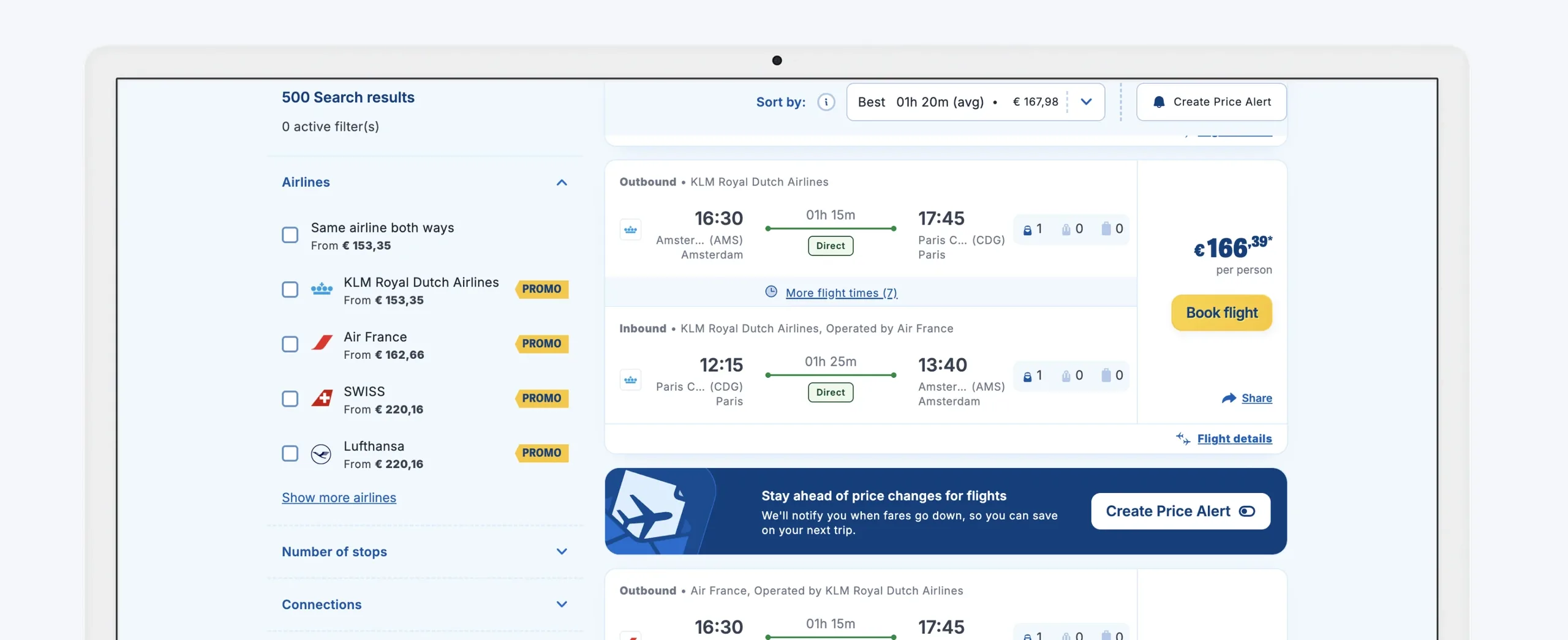
The results page with the Price Alert module after the first results, for the search used throughout: Amsterdam to Paris, Tu 15 Sep to Tu 22 Sep.
- Role
- Senior Product Designer. Growth strategy, concept design, interaction design, email continuation, consent and post-launch evaluation
- Product
- CheapTickets flight search, at Travix, part of Trip.com Group
- Delivery
- Three-month proof of concept
- Year
- 2025
- Collaborators
- Product management, engineering, marketing, legal and email-platform stakeholders
Travellers often leave before they are ready to decide.
CheapTickets attracted flight-search traffic through direct channels and metasearch platforms such as Skyscanner. But not every traveller was ready to book during the first session.
Some customers were comparing destinations, coordinating with others, waiting for a better price or still deciding whether the trip was affordable. When they left, the product relationship largely ended even though their travel intent had not disappeared.
Price-sensitive travellers had to monitor the journey themselves.
Flight prices change constantly. Customers who were not ready to book had to keep the search open, repeat the same search later, compare across sites, remember the previous price or book earlier than they wanted because they feared the fare might rise.
The business had already invested in acquiring the visit, but there was no lightweight mechanism for maintaining a useful relationship while the traveller was still deciding.
A useful notification could extend the value of flight search.
Price Alerts were not only an email-capture idea. They were a way to preserve unresolved search intent.
The PM’s growth hypothesis was that monitoring a flight search for the customer could reduce effort, support more considered decision-making, increase returning traffic and create another relevant opportunity to book.
- 1Searcha flight
- 2DiscoverPrice Alerts
- 3Activatean alert
- 4Notifya useful notification
- 5Returnto their search
Continue comparison
I reviewed more than 15 travel products.
The competitor review explored where alerts appeared, whether an account was required, what was monitored, how price movement was communicated, whether customers could set target prices, how alerts were managed and how consent or unsubscribe behaviour worked.
The strongest propositions reduced customer effort before asking for commitment. Account requirements often introduced friction before value had been demonstrated.
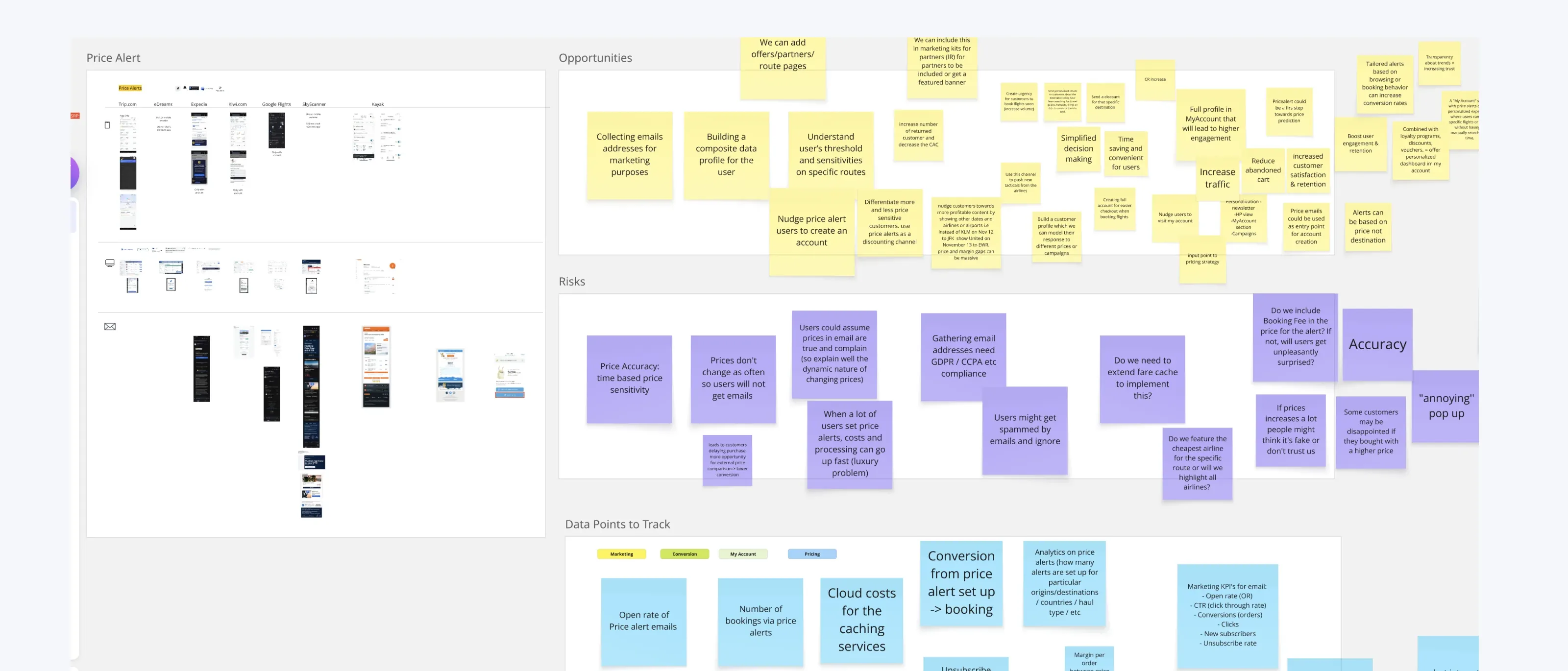
My concepts helped stakeholders see a larger opportunity.
In early work I explored route-level monitoring, desired-price alerts, price comparison and history, search-result alerts and flight-specific tracking. These concepts helped stakeholders understand that Price Alerts could become a longer-term decision-support system for flexible travellers.
That alignment helped secure a three-month proof-of-concept window. From there, we separated the broader strategic opportunity from the minimum product needed to begin learning.
- Route-level monitoringTrack the lowest fare for a route and date range.
- Desired-price alertsNotify the traveller when a fare reaches a chosen target.
- Price comparison and historyShow whether today’s fare is high, low or typical.
- Search-result alertsTrack the exact search the customer ran.
- Flight-specific trackingTrack one itinerary rather than the whole search.
We prioritised a reliable feedback loop over advanced configuration.
Broader opportunity areas explored before the MVP was narrowed. Only the reduced MVP shipped.
- Three notification states: price decreased, increased or unchanged.
- Customers only needed to provide an email address.
- Target-price thresholds
- Predictions
- History charts
- Frequency controls
- Account-based management
- Advanced personalisation
The loop, stage by stage
My design work at each stage, in the order the traveller meets it.
-
Search
The traveller compares flights on the search-results page.
-
Discover
At launch the way in was kept quiet. This is the stage that leaked; the results show where.
-
Activate
The activation flow had to earn the email request.
I designed the flow to keep the customer in search-results context. No account was required, because the feature appeared before the customer had committed to Travix or to the trip.
The activation modal needed to explain what was being monitored, set a realistic expectation about notifications, make the email request feel proportionate and confirm that monitoring had started.
-
Notify
The product value was delivered later through email.
I designed each notification to communicate the route, dates, previous price, current price, price movement, route back to the search and a way to stop the alert.
The email experience mattered because Price Alerts were a cross-channel product. The alert was only useful if it helped the customer understand what changed and return to their search with enough context to continue deciding.
Each email did four jobs, in the order a traveller reads them.
The price-decreased email, cut at its four parts. Select a part to see how it works. #1
Say what changed before anything else.
Three notification states carried the whole proposition: the price decreased, increased or stayed the same. I made the top of every email answer the one question the traveller has, whether the price moved, before it shows the trip.
- Principle
- The change is the news. The traveller should not have to work out the difference between two prices.
- Decision
- One template, three states. The headline, trend mark, sentence, change chip and price switch together; the route, dates, fare details and Book Now stay where they are.
Switch the state to compare the three emails. Point at a number to read what that part says. #2
Turn the price into advice.
A price on its own does not tell a traveller what to do with it. Under the trip card, Our recommendation gives one line of advice, powered by a pricing engine that compares the trip’s historical prices with today’s price.
- Principle
- History charts and predictions were left out of the MVP. The history still reached the traveller, as one sentence they could act on rather than a chart to read.
- Decision
- Read today’s price against the trip’s history, not against the last email. At the lowest price seen in over a week, buy; above the price it has held, wait.
How the recommendation is chosen, and the recommendation each state’s email carries. An unchanged price gets the same advice as a decrease: it is judged against the week, not against the last email. #3
Show flexible travellers what moving the trip would save.
Some travellers waiting on a price can also move the trip. The second half of the email asks Are your plans flexible? and lists similar dates and routes, each priced and tagged with the reason it is there, from a Summer deal discount to an alternate airport.
- Principle
- Watching a price is passive. Options give the traveller something to act on while they wait.
- Decision
- Keep the trip’s seven nights and one passenger, move the departure from a day earlier to three days later, and tag each option: a Summer deal shows the discounted fare beside the old one, an alternate airport is named before the traveller opens it.
I treated consent as part of the product.
The team reused existing transactional-email infrastructure rather than building a new mailing system, which helped keep the proof of concept achievable. That decision also made consent boundaries important.
Price Alerts and marketing communication represented separate permissions. Stopping a Price Alert could not be treated as the same thing as unsubscribing from marketing, and unsubscribing from marketing could not automatically remove a separately requested service alert.
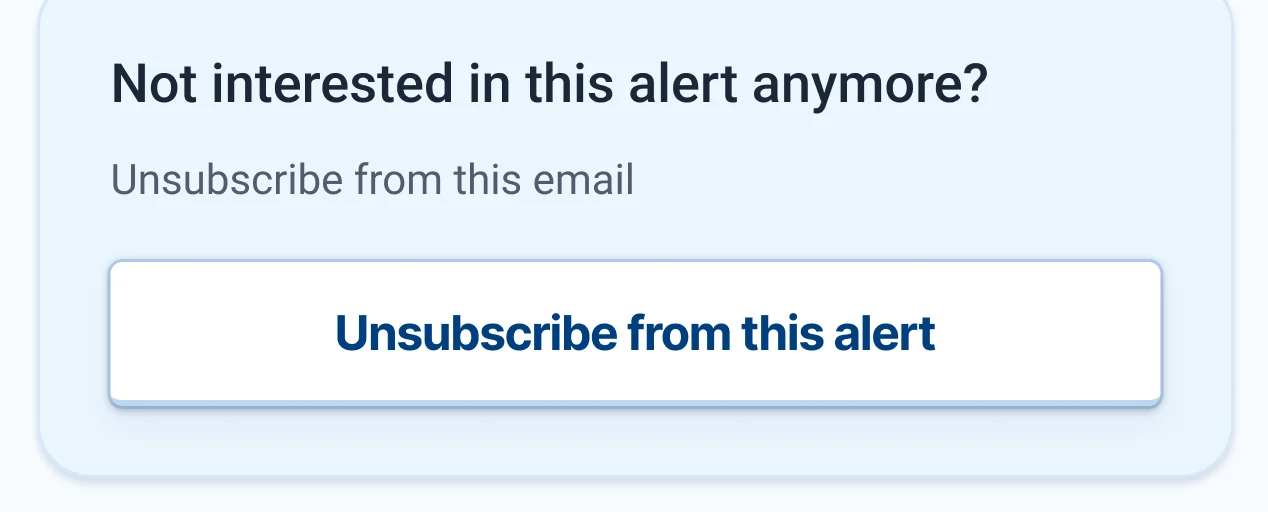
The way out at the end of every alert email names the alert: Unsubscribe from this alert stops this alert and touches nothing else. Price Alert consent
Given when the customer creates an alert. Stopped independently, at any time.
Stop alert: does not touch marketing
Transactional-email infrastructure
delivery, templates, tracking
Carries both, merges neither
Marketing consent
Separate opt-in. Unsubscribing here never removes a requested service alert.
Unsubscribe: does not stop alerts
Never inherited from one another
- No account required
- No implied marketing opt-in
- Independent unsubscribe
- No guaranteed-savings claim
Consent model showing Price Alerts as a service communication with separate marketing preferences. -
Return
Back to their search, to continue comparison. Back to stage 1
We launched quietly to validate the mechanics first.
The release was not a conventional A/B test. It was a soft launch with minimal prominence, intended to reduce implementation risk while monitoring early behaviour.
- alert creation
- email validation
- search association
- price-state triggers
- email rendering
- return links
- separate unsubscribe behaviour
- duplicate and failure states
- GDPR-related behaviour
Customers who entered the flow often completed it, but almost no one entered.
My post-launch analysis revealed a sharply uneven funnel, measured stage by stage below.
Two orders were attributed to Price Alert email traffic in July 2025. This showed the mechanism could generate return sessions and bookings, but the volume was too low to claim incremental conversion, revenue uplift or a validated growth channel.
The loop, measured
-
1Search
100%
of search-results traffic
Reached search results
-
2DiscoverWhere it leaked
0.03%
of search-results traffic
Interacted with Price Alert
-
3Activate
23–32%
of customers who clicked
Submitted an alert
-
4Notify
–
Delivery, opens and clicks are part of the proposed measurement
-
5Return
–
Return sessions are part of the proposed measurement
2 orders were attributed to Price Alert email traffic in July 2025: a count of bookings, not a rate.
The main failure was discovery, not proof that the alert proposition had no value.
Changing the entry point moved both numbers.
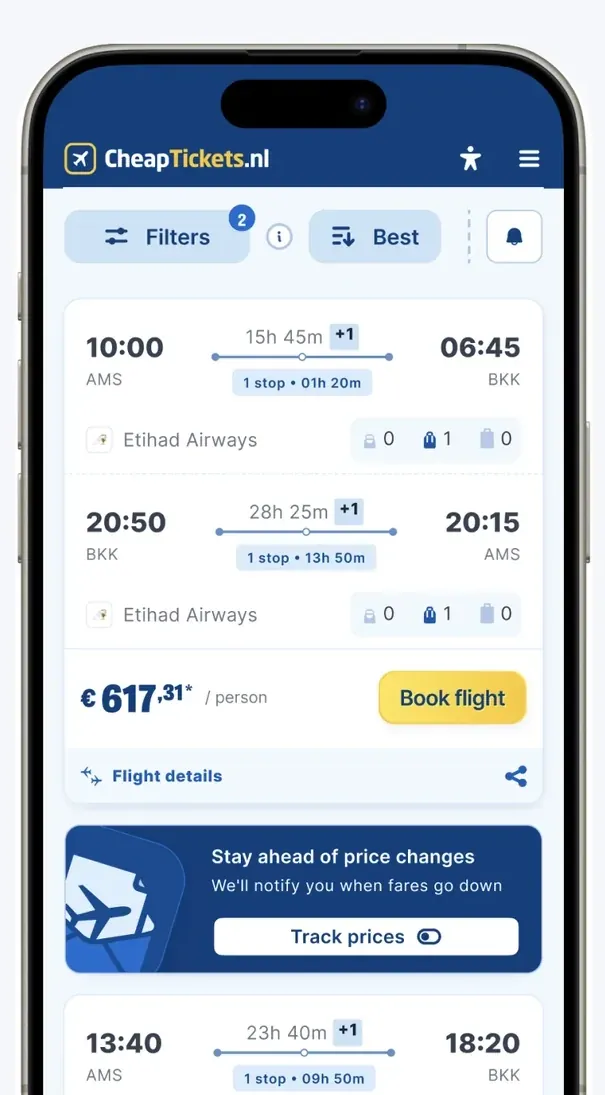
The funnel pointed at one thing. The proposition worked for the few customers who found it, and almost nobody found it. So I redesigned the way in rather than the product: a clearer, more explicit Price Alert action in place of the ambiguous control.
Interactions with the action increased by 43% and alert creation by 31%. Both figures are relative to the previous entry point rather than absolute rates, and from the launch baseline above the absolute numbers remain small. It was enough to justify the next move: Price Alerts are now being promoted directly within the search-results page.
Move Price Alerts from hidden utility to contextual decision support.
With the entry point addressed, the remaining work is relevance and placement rather than advanced configuration: putting the proposition near the moments of comparison or indecision, which is what the search-results promotion is testing.
- 1DiscoveryImpressions, CTR, placement
- 2ActivationSubmission, errors, time
- 3EngagementDelivery, opens, clicks
- 4ReturnRestored search, relevance
- 5CommercialIncremental booking, margin
Commercial signal re-enters discovery
- randomised exposure
- a control group
- full-funnel instrumentation
- return measurement
- guardrails for unsubscribe, complaints, page performance and customer confusion
What this project taught me.
This project taught me that growth features need distribution as much as utility. Placement is part of the product, not a separate marketing concern.
The soft launch reduced risk, but it also prevented meaningful learning about demand. The better question became: where and when should Price Alerts enter the flight-decision journey?
A feature does not become a growth loop merely because it can bring someone back. It becomes a growth loop when customers discover it, understand its value, trust it and return because it helped them make a better decision.